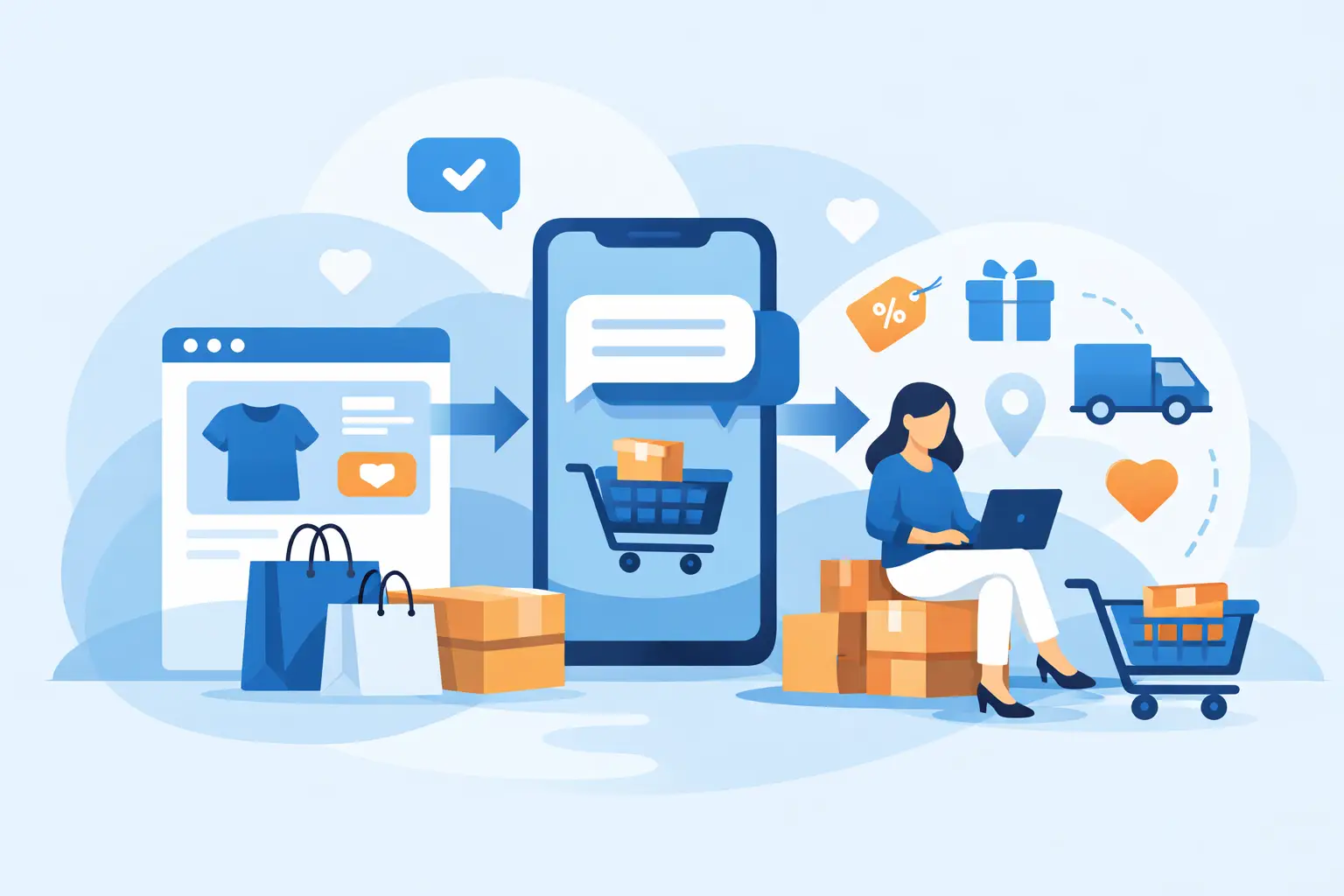
An online store loses money every day for three simple reasons: abandoned carts, customers who forget to return, and messages sent too late. A well-constructed SMS flow for ecommerce addresses exactly these points without burdening the team with complicated processes and without turning the channel into a source of spam. SMS works when it has a clear role in the customer journey, not when used randomly.
For ecommerce, the advantage is direct. Email remains useful, but SMS wins in speed, visibility, and immediate response. This makes it suitable for moments when timing matters: confirmations, cart recovery, stock alerts, delivery updates, and reactivation. However, good results do not come from volume, but from the logic of the flow.
What a sample SMS flow for ecommerce looks like
The most effective flow does not start with the promotion, but with the customer's consent. If the database is not collected correctly, any subsequent automation starts off wrong. Moreover, a valid and updated number makes the difference between wasted cost and delivered message.
A healthy flow typically has five stages: capture, conversion, post-purchase, retention, and reactivation. Not all brands need the same intensity at each stage. A store with frequent purchases will invest more in retention. A store with high ticket items will focus on cart abandonment and follow-up after browsing.
1. Capturing subscribers without friction
The first step is simple: offer a clear reason for subscribing and ask for the minimum necessary. In many cases, the phone number and explicit consent are sufficient. If you add too many fields, the sign-up rate decreases.
The initial message must confirm the subscription and set expectations. For example: “You have successfully subscribed to our SMS alerts. You will receive updates on offers, stocks, and orders. You can unsubscribe at any time.” If you promised a discount code, it must be sent immediately. Not in an hour, not in a separate email.
Here comes the first compromise. A larger discount brings more sign-ups but may also attract opportunistic customers who buy only once. A smaller but relevant benefit better filters the audience. It depends on the margin, category, and objective.
2. Recovering the abandoned cart
Here SMS often delivers the fastest impact. The customer has almost reached the purchase but exited the process. You don't need a long speech. You need context, timing, and a short message.
The first SMS can be sent 30-60 minutes after abandonment: “You left products in the cart. Your order is waiting for you. Complete it now while stock is available.” If the store works with limited stock, this wording makes sense. If not, it's better to avoid artificial urgency.
The second message, at 20-24 hours, can add an incentive. Not for everyone. If you automatically send a discount for every abandonment, you train customers to wait for the discount. It's more effective to segment: new customers, high cart value, products with good margins, or users who have abandoned multiple times.
A third message is useful only in certain cases. For expensive products or purchases that require comparison, yes. For cheap consumables, it often isn't worth it. Too many messages reduce response and increase unsubscribes.
The post-purchase flow does more than confirm
Many retailers use SMS only for order confirmation. It's a good start, but insufficient. The post-purchase stage is one of the most valuable for trust and repeat purchases.
The first message is transactional and must arrive immediately: order confirmation, possibly with an order number. The second useful message is the delivery update. The customer doesn't want to search for information in the account or email if they can quickly receive relevant status on their phone.
Then comes the part many stores miss: follow-up after delivery. At 3-7 days, you can send a different message depending on the product. For cosmetics or supplements, it makes sense to ask if the product arrived well and suggest a complementary item. For fashion, you can ask for feedback or a review. For electronics, a support message or activation instructions can reduce returns and support requests.
Here it is very important to separate service messages from commercial ones. The customer easily accepts notifications about the order. They will accept a much more aggressive promotion immediately after delivery. Order matters.
3. Retention based on behavior, not calendar
A good flow doesn't mean sending “a campaign every Friday.” It means using real signals. When they last purchased, what category they prefer, what the average restocking frequency is, what the customer's value is, and how sensitive they are to discounts.
A simple example: if you sell consumable products that run out in 30 days, send a reminder on day 25-28. Not a generic message, but one related to usage: “It's probably time to restock. Reorder in a few clicks.” This is more relevant than a promotion sent randomly.
For high-value customers, you can build different flows. Early access to launches, restocking alerts, limited offers on favorite categories. For inactive customers, the tone should be more cautious. If they haven't responded for months, a single well-chosen message is more effective than three insistent ones.
Sample 30-day SMS flow for ecommerce
As a practical model, an online store can set a basic flow like this.
Day 0: SMS subscription with confirmation and possibly a welcome code.
Day 1: if there is abandoned browsing or cart, a return message adapted to the context.
Day 2: second recovery message only for eligible segments.
Day 3 or 4: order confirmation and status, if the purchase was completed.
Day 7: post-delivery message for feedback, review, or usage recommendation.
Day 21-30: restocking reminder or complementary recommendation, depending on the product type.
Day 45 or 60: reactivation for customers who have not interacted, with a clear offer or a real reason to return.
This model is not universal. If you have long purchase cycles, compress less and wait longer between messages. If you have recurring products, you can accelerate automations. The important thing is to start from the customer's behavior, not the team's desire to send more.
4. What each message should contain
A good SMS for ecommerce has four elements: clear brand identification, precise context, a single objective, and an easy-to-understand call to action. If you try to say too much in the same message, response decreases.
The tone should be direct and useful. Don't force enthusiasm. Phrases like “incredible offer” or “last chance” work only when they are real. Otherwise, they erode trust. For transactional messages, clarity beats creativity. For commercial messages, relevance beats frequency.
Timing also matters. A cart reminder at midnight can cause irritation. A stock alert sent too late can miss the purchase intent. Testing sending times is an operational component, not a secondary detail.
Where the most common mistakes occur
The first mistake is lack of segmentation. Sending the same message to everyone is convenient but costly. New customers, loyal customers, and inactive ones do not respond to the same arguments.
The second mistake is mixing marketing infrastructure with operational infrastructure. If you miss delivering critical messages or cannot scale quickly during peak periods, the customer experience suffers exactly when volume increases. For many teams, a partner who can support both campaigns and transactional messaging without unnecessary complications matters here.
The third mistake is ignoring the quality of the database. Invalid, duplicate, or old numbers reduce performance and consume budget. Validating numbers and constantly checking data quality have a direct impact on cost and deliverability.
The fourth mistake is measuring only clicks. In ecommerce, the real value lies in conversion, revenue per message, return rate, and impact on support or returns. Some flows do not bring many clicks but reduce friction and increase trust. This is reflected in sales and lower operational costs.
When it is worth automating more advanced
If you already have volume and multiple data sources, you can take the flow to a more profitable level. For example, you can combine SMS with real-time stock, delivery status, order history, or number validation before sending. For teams that want better control, integration through API shortens times, reduces errors, and allows flows triggered at exactly the right moment.
Here lies the difference between a tool that just sends messages and an infrastructure that supports growth. If you run campaigns, you need speed and simplicity. If you also manage critical notifications, you need stable delivery, clear rules, and operational visibility. SMSense fits well in this type of scenario, especially for businesses that want to combine SMS marketing with transactional messages and technical automations without cumbersome implementations.
A good SMS flow for ecommerce is not the longest nor the most creative. It is the one that arrives on time, says exactly what it needs to, and has a clear role in the customer's decision. If you start from these principles, you will send fewer unnecessary messages and get more from each interaction.