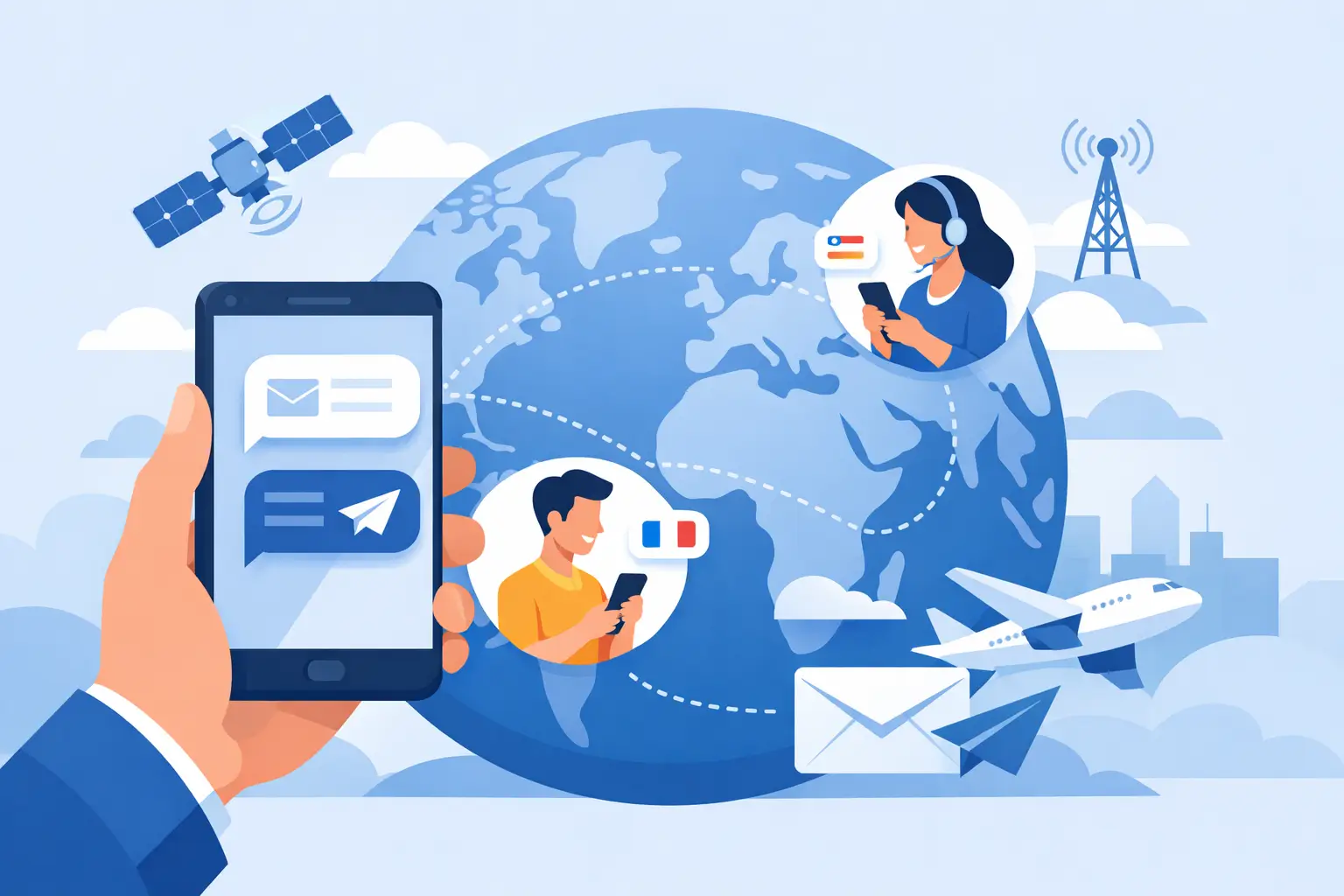
If you have ever tried to contact a client from another country, you know that the question is not just how to send international SMS, but how to do it quickly, safely, and without surprises in cost or delivery. For a personal message, the phone may be enough. For notifications, campaigns, OTP, or transactional messages sent at scale, things change immediately.
International SMS remains one of the most direct communication channels. It does not require the installation of an app, does not depend on the recipient's internet connection, and has a visibility rate hard to match. That's why it is used by online stores, support teams, software platforms, financial services, and companies that need to deliver information on time.
How to send international SMS depending on the need
There are two very different scenarios. The first is the occasional one: you want to send a message to someone in another country directly from your phone. The second is the operational one: you need to send large volumes, to multiple markets, with traceability, automation, and cost control.
If you are sending from a phone, you generally need the full number in international format, with the country prefix and without the local zero at the beginning. For example, instead of a locally saved number, you use the format with plus and country code. In many cases, the message is sent immediately, but the cost depends on the operator, and the real delivery confirmation is limited.
If you are sending from a business platform, the process is different. Instead of relying on the tariff plan of a single operator, you work with infrastructure built for international delivery. You can import contacts, segment databases, set custom senders where accepted, track statuses, and integrate sending via API into your applications.
This is where the difference between a simple sent message and communication that truly supports company operations appears.
What you need to check before sending an international SMS
The first thing is the number format. It seems trivial, but it is one of the most common causes for delivery failure. The number must be entered in the correct international format, with a valid country prefix. If you work with large databases, checking the format is no longer optional.
The second aspect is coverage in the destination country. Not all routes have the same cost, speed, or rules. In some markets, promotional messages are treated differently from OTP or transactional notifications. In others, the alphanumeric sender is allowed but may require prior registration.
The third is the type of message. A marketing SMS and an authentication code have different priorities. If you send an offer, segmentation and cost-effective delivery rate matter. If you send an OTP, speed and predictability matter more. The choice of infrastructure and routes should consider this.
There is also the compliance part. When communicating with users from other countries, you need to know if you have consent for sending, how you manage unsubscribes, and what local rules apply. SMS is very effective, but that's why it must be used correctly.
How to send international SMS from a phone and where the limits appear
For personal use or very small volumes, the phone is the simplest option. You write the message, choose the number in international format, and send. If your operator allows traffic to that country, the message arrives.
The problem arises when you want more control. You don't know exactly how much each country costs without checking the operator's rates. You can't segment audiences. You don't have clear reports for campaigns. You can't automate order notifications, confirmation messages, or security alerts. And, perhaps most importantly, you don't have the flexibility a business needs when volume increases.
In short, the phone solves specific issues. It does not solve operational ones.
When you need a dedicated platform
If you send messages to clients, users, or partners regularly, a dedicated platform becomes the efficient choice. Not just for volume, but for clarity. You see costs per country, separate campaigns from transactional messages, can work with clean lists, and reduce the risk of sending to invalid numbers.
For marketing teams, the main advantage is execution speed. You upload contacts, select the market, customize the message, and launch the campaign without cumbersome processes. For technical teams, the value comes from the API, from the ability to automatically send confirmations, OTP, alerts, or notifications directly from the product.
For companies operating in multiple countries, the right platform also offers auxiliary tools that matter more than it seems at first glance. HLR Lookup helps you see if a number is active and can receive messages. MNP lookup becomes useful when you need better routing or more precise network data. These details have a direct impact on cost and delivery.
Costs, delivery, and why the lowest price is not always the best
In international SMS, the temptation is to compare only the rate per message. It is useful but incomplete. A low price doesn't help if the message arrives late, has a poor delivery rate, or goes through routes that are not suitable for your type of traffic.
For example, for promotional campaigns, you can accept small speed variations if you achieve good cost efficiency. For one-time passwords or account verification, a few extra seconds can affect conversion or user experience. Here, the quality of routing and infrastructure stability matter.
There are also hidden costs of an unclean database. If you send to wrong, inactive, or duplicate numbers, you pay without result. That's why number validation and contact hygiene are as important as the displayed rate.
What good delivery means at an international level
Good delivery doesn't just mean that the message was accepted by the system. In practice, you need visibility over statuses, consistent times, and the ability to adjust flows depending on the country and use case.
For transactional messages, good delivery means predictability. The client places an order and receives confirmation immediately. The user requests a password reset, and the code arrives on time. For marketing, good delivery means coverage, well-chosen sending windows, and messages adapted to the local context.
If you send globally, not all markets react the same. Some respond very well to promotional SMS. Others are more sensitive to frequency or message wording. That's why performance comes not only from technology but also from operational discipline.
How to choose the right solution for your company
Start with volume and purpose. If you need a few dozen messages a month, the solution can be simple. If you send notifications, marketing messages, and OTP daily in multiple countries, you need a platform that can support all these flows without mixing them.
Then look at onboarding. A good solution should let you start quickly, without unnecessary installations and without complicated negotiations for an initial test. At the same time, it should be able to grow with you, whether you want self-serve campaigns or API integration.
Support matters more than it seems. When you deliver messages with a commercial or critical role, you need a quick response, not lost tickets. The same goes for transparency in pricing, payment options, and access to features like 2-way SMS, custom sender ID, or number verification.
For many companies, a platform like SMSense makes sense precisely because it covers both the campaign and bulk messaging side, as well as the technical needs for authentication, verification, and automation. This reduces fragmentation and makes managing international communication simpler.
Common mistakes when sending SMS to other countries
The most common mistake is using unvalidated lists. The second is assuming that the same strategy works identically in any market. It doesn't. The sending schedule, message language, sender type, and even text length can change results.
Another mistake is treating all messages the same. Campaigns, alerts, and OTPs have different objectives. If you run them on the same logic, you lose either efficiency or control. Clearly segment and build flows around the desired outcome.
Finally, don't ignore measurement. Without reports, statuses, and feedback from results, you're sending blindly. And when communicating internationally, blindness costs.
If you're wondering how to send international SMS professionally, the correct answer is not just "write the message and press send." The right answer is to choose the method that fits your volume, risk, and objective. When communication matters for sales, support, or security, real simplicity comes from a system that delivers consistently and allows your team to move quickly.