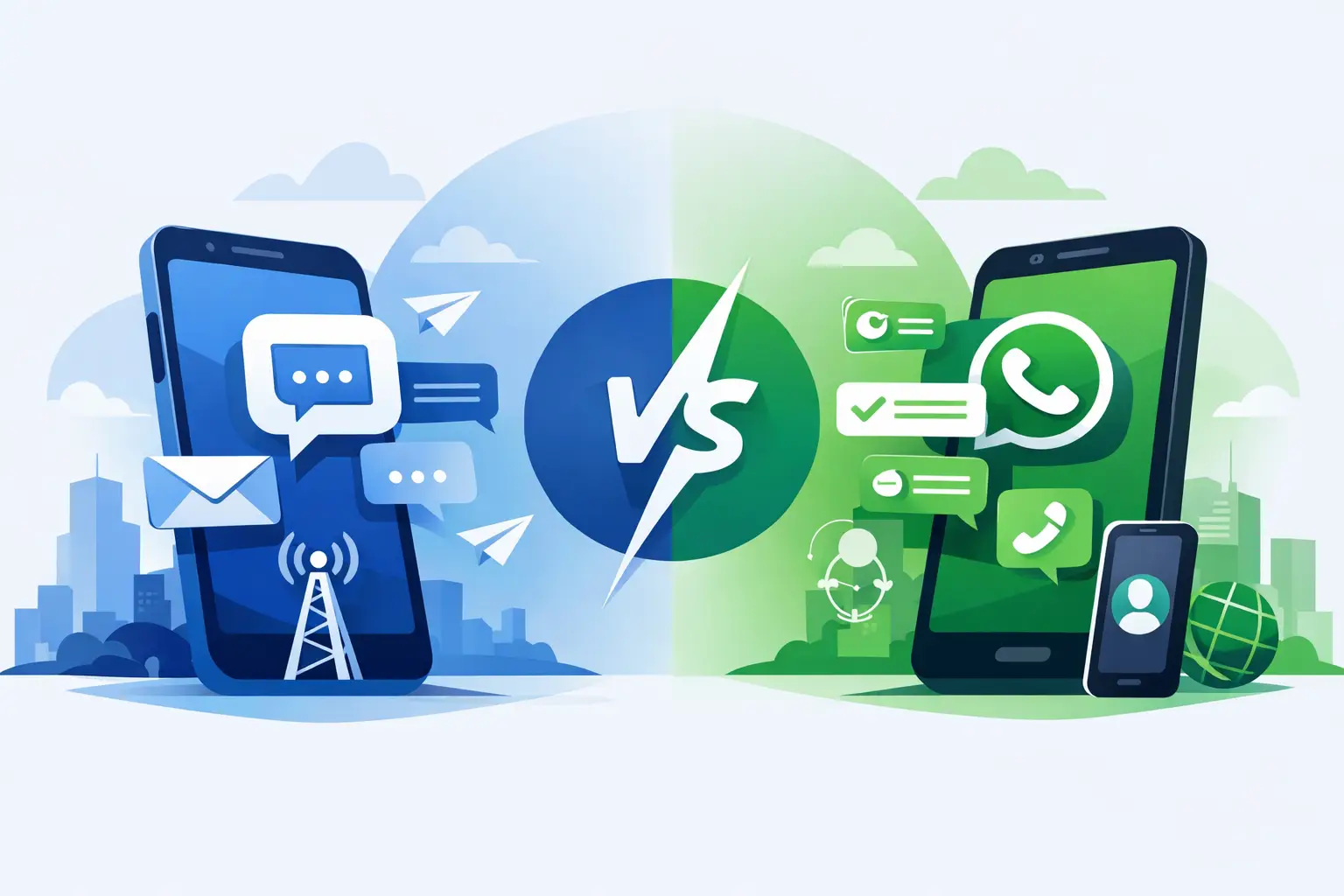
If you send a campaign and need the message to reach now, not in a few hours and not just to users who have installed an app, the real question is not which channel is more popular. The question is which channel offers you coverage, control, and results. In the discussion about mass SMS vs WhatsApp, the difference is not just in cost per message, but in how securely you can activate, inform, or convert a client.
For many companies, the temptation is clear. WhatsApp seems more modern, more conversational, and cheaper in certain scenarios. SMS seems simpler, more direct, and more universal. But when you look from an operational perspective - marketing, notifications, OTP, support, abandoned order recovery, delivery confirmations - the correct choice depends on the objective, audience, and level of predictability you need.
Mass SMS vs WhatsApp: the basic difference
SMS works on almost any mobile phone, without installation, without an account, and without connection to a specific app. This makes it a very good channel when the priority is fast delivery to a wide audience. For promotional campaigns, transactional alerts, or identity verifications, its simplicity becomes a direct business advantage.
WhatsApp works differently. It is an app-based messaging channel, with a richer experience and greater potential for conversations. You can send images, buttons, templates, and build more interactive support or engagement flows. But you depend on the user having the app installed, having internet access, and being able to receive messages in that environment.
This is where the first serious decision arises. If you want almost universal coverage, SMS has a clear advantage. If you want rich interaction and conversations in a channel already familiar to many users, WhatsApp might be more suitable.
When SMS clearly wins
For companies that value delivery rate, speed, and simplicity, SMS remains hard to replace. It is a powerful channel for time-sensitive communications: OTP codes, authentication, appointment confirmations, status notifications, payment alerts, or short-term promotional messages.
The reason is simple. SMS does not require the user to do anything extra. They don't need to download an app, activate notifications, or save your number. The message goes directly to the phone's native inbox. For businesses, this means fewer variables and more control.
There is also another important advantage: the database. Almost every company has phone numbers in their CRM or commercial systems. However, not all companies have the consent, setup, or infrastructure for WhatsApp Business at scale. If you want to quickly start a campaign or activate automated notifications, SMS is often the shorter path.
Additionally, for technical cases, such as number verification, authentication, and API flows, SMS naturally fits. It is direct, predictable, and easy to integrate into critical processes.
When WhatsApp makes sense
WhatsApp is powerful when communication doesn't stop at a single message. If your team wants conversations, support, follow-up, and a more chat-like experience, the platform can bring real value. For lead nurturing, customer care, or messages that benefit from images and quick responses, WhatsApp offers more context than a classic SMS.
Also, for brands working with highly active audiences in messaging apps, WhatsApp can generate richer interactions. A client can respond more easily, continue the discussion in the same thread, and receive an experience closer to live support.
However, this advantage comes with conditions. You must respect the platform's rules, approved templates, and conversation windows. In some cases, the approval and management processes are stricter than in SMS. For some companies, this is perfectly acceptable. For others, it is unnecessary operational friction.
Delivery, opening, and reaction time
If you look at mass SMS vs WhatsApp through the lens of performance, you need to separate three things: delivered message, seen message, and message that produces action.
SMS has a strong advantage in delivery and immediate visibility. The phone displays the message natively, and the user notices it quickly. That's why it works very well for urgent and simple messages. When you tell a client that the delivery arrives today, that they have a confirmation code, or that the offer expires at 8:00 PM, speed matters more than the message design.
WhatsApp can have a better experience after opening, but it doesn't always win at the first step. If app notifications are turned off, if the message enters a crowded context, or if the user doesn't actively use the channel, the reaction may delay. This doesn't mean WhatsApp performs poorly. It just means it is more dependent on in-app behavior.
For commercial campaigns, it's worth testing. For critical messages, many companies prefer the predictability of SMS.
The real cost is not just the cost per message
One of the most common mistakes is to compare channels only by rate. The seemingly lower cost does not automatically mean better efficiency. The real cost includes delivery, implementation time, reading rate, platform dependency, internal resources, and impact on conversion.
An SMS may seem more expensive per unit than a message sent in a chat channel, but if it reaches more securely and produces faster action, the cost per result may be better. Similarly, WhatsApp can be very efficient if you already have support processes, approved templates, and a client base that prefers that channel.
For retail, e-commerce, and local services, the right decision often comes from the type of message. Short promotions, alerts, and urgent notifications tend to perform very well in SMS. Support conversations, reconfirmations, and longer interactions may work better on WhatsApp.
Control, compliance, and operational risk
When a channel becomes part of your business processes, control matters. SMS generally offers more operational independence for standard communications. You can upload contacts, segment, automate through API, and send quickly without relying on a closed conversational environment.
WhatsApp comes with more specific rules regarding templates, conversation initiation, and platform policies. This model is useful for maintaining the quality of the experience, but for some teams, it can mean extra time and less flexibility. If you need to quickly scale notifications or authentications, every extra step counts.
Therefore, for companies seeking predictability and rapid onboarding, SMS infrastructure remains a safe bet. Especially if you can manage marketing campaigns, 2-way messaging, OTP, and number verifications on the same platform.
What to choose for marketing, support, and notifications
For marketing, the answer depends on how simple or conversational you want the message to be. If the goal is rapid reach, promotional code, reminder, or immediate traffic, SMS is very efficient. If the goal is to start a dialogue or present more context, WhatsApp may win.
For support, WhatsApp has a natural advantage due to its chat interface. The client responds easily, the agent can continue the discussion, and the experience is closer to a normal conversation. However, SMS can also work well in simple support or quick confirmations, especially with two-way messaging.
For notifications and security, SMS remains the standard choice for many companies. OTPs, account verifications, and critical alerts require fast delivery and wide coverage. Here, the simplicity of the channel makes the difference.
A mature choice is not always either-or
Many businesses don't need to choose exclusively between these channels. They need to know what role each plays. SMS can be the basic channel for reach, urgency, and critical processes. WhatsApp can be the complementary channel for conversation, support, and deeper engagement.
This is, in fact, the most useful perspective for teams that want results and not complications. You don't choose the "cooler" channel. You choose the channel that reduces friction between you and the client at that precise moment.
If a user needs to receive a code now, send it via SMS. If a client needs a discussion with multiple message exchanges, use a conversational channel. If you run large-scale campaigns and want quick implementation, clear reporting, and simple integration, a reliability-oriented platform like SMSense offers you a much more practical starting point.
The right choice is not about fashion, but about fit. The more important the message is to your operation, the more it is worth choosing the channel that lets you sleep peacefully after you press Send.