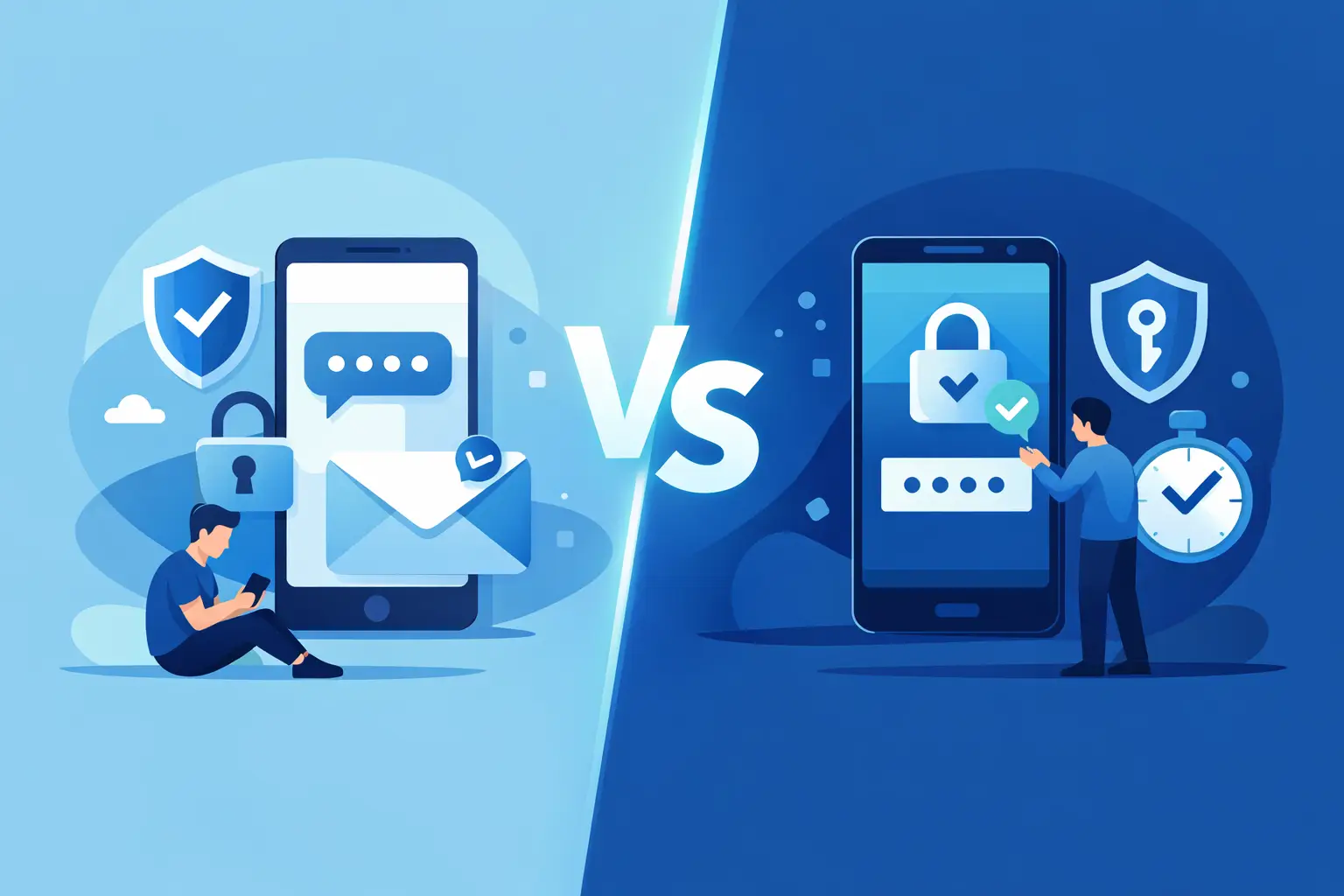
When the discussion turns to securing accounts, choosing between OTP SMS vs app authentication is not just a technical decision. For many companies, it directly influences login rates, operational costs, support volume, and exposure to fraud. If you manage a digital product, an online store, or a large-scale authentication flow, it's worth choosing the method that offers the right balance between security, speed, and user ease.
OTP SMS vs app authentication - what is the real difference?
At first glance, both methods do the same thing: they add a second verification step over a password or a login process. The difference lies in how the user receives the code and how much control the company has over the experience.
OTP via SMS sends a unique code to the user's phone number. It is familiar, easy to understand, and does not require the installation of an additional app. For business, this means quick onboarding and good adoption even among less tech-savvy users.
App authentication generates codes in an authenticator-type app installed on the phone. The code changes at short intervals and does not depend on the mobile network for each login. From a security perspective, this option is usually stronger. From an operational perspective, it can introduce more friction at activation.
Therefore, the correct comparison is not just about which method is theoretically safer. It's about what works better for your users, your business risk, and your internal resources.
When OTP via SMS is the better choice
SMS remains one of the most efficient methods for verification when speed and accessibility matter. If you need to quickly validate a phone number, confirm identity at checkout, approve a transaction, or activate a new account, OTP via SMS reduces unnecessary steps.
The main advantage is clarity. The user does not need to understand how an authentication app works, does not need to scan QR codes, and does not need to make additional settings. They receive the message, enter the code, and continue.
For e-commerce, platforms with a wide audience, delivery services, fintech with quick onboarding, or apps where conversion is critical, this matters. Every extra step decreases activation. When the goal is to allow quick access without completely sacrificing security, OTP via SMS has a clear commercial advantage.
There is also the recovery component. Many users change their phones, delete apps, or lose access to security settings. A code received via SMS is, for them, more intuitive than restoring an authenticator.
Where app authentication has the advantage
App authentication becomes more attractive when advanced security is the main priority. Codes do not travel through the SMS network with each login attempt, reducing certain risks associated with interception, redirection, or SIM swap attacks.
This method is especially suitable for accounts with sensitive access, enterprise platforms, administrative panels, internal systems, or products that manage critical data. If your users are already accustomed to stricter security practices, introducing an authentication app will not seem like a major burden.
There is also the advantage of variable cost. Once the user has activated the app, you no longer pay for an SMS for each authentication. At very high volumes and high login frequency, this aspect can weigh heavily in the cost model.
However, a compromise must be accepted. The initial setup is more sensitive, and the abandonment rate may be higher if the audience is not tech-savvy or if your product requires immediate activation.
Security: differences that really matter
In the OTP SMS vs app authentication discussion, security is usually the first argument. But even here, simplistic answers should be avoided.
Yes, authentication apps are generally considered more secure. They do not depend on telecom delivery for each code and are less exposed to forms of fraud related to number porting or SIM card compromise.
On the other hand, OTP via SMS can offer a very good level of protection for many commercial scenarios, especially if implemented correctly. Rate limiting, detecting suspicious behavior, number validation, rapid code expiration, and monitoring attempts significantly reduce risk.
The problem arises when companies treat SMS as an isolated solution. In practice, good security comes from architecture, not from a single channel. If you have high-risk transactions, sensitive data changes, or access to critical information, a combination of methods or adaptive authentication is often a healthier choice than a rigid "SMS only" or "app only" stance.
User experience and conversion impact
For many product teams, the real question is not what method the security department likes, but what method more users complete without additional support. Here SMS has a clear advantage in most consumer-oriented flows.
SMS works well because it is already part of daily behavior. The user needs almost no education. This is especially evident at first activation, password reset, and occasional logins.
App authentication is better for recurrent users familiar with stricter digital processes. If the platform is used daily and access is valuable, these users more easily accept the additional step.
If your audience includes non-tech-savvy customers, people making quick purchases from mobile, or international users with very different expectations, the simple SMS experience can have a direct effect on activation and retention.
Costs and operational scaling
Cost should not be calculated only per message. It should be analyzed in relation to fraud, support, and completion rate.
OTP via SMS involves a direct cost for each sending. At small and medium volumes, this is often justified by the simplicity of implementation and better conversion. At large volumes, especially in international markets, costs can increase and must be carefully managed through good routing, anti-abuse rules, and optimizing sending frequency.
App authentication reduces this recurring cost but can shift the pressure elsewhere. You will need clear UX for activation, access recovery procedures, support for changed devices, and sometimes greater resistance to onboarding.
For companies sending large volumes of OTP and wanting operational control, the choice of SMS provider matters almost as much as the choice of method. Delivery reliability, speed, international coverage, and API tools directly influence the outcome. Here a platform like SMSense can make sense for teams wanting quick implementation and scalable infrastructure without unnecessary complexity.
What to choose based on the type of business
If you manage an online store, a booking platform, a delivery service, or an app aimed at a wide audience, OTP via SMS is often the most practical choice for verification, authentication, and quick confirmation. It reduces friction and helps users complete the flow on the first try.
If you manage enterprise software, internal access, sensitive data, or administrative roles, app authentication usually offers a better level of control and a stronger security posture.
If you have different user segments, the best decision may be to offer both options. Standard users can start with SMS, and high-risk or extended permission accounts can be moved to the app. This approach reduces abandonment without ignoring security.
OTP SMS vs app authentication - a simple decision framework
If your priority is rapid adoption, obstacle-free onboarding, and wide coverage, choose SMS. If the priority is advanced security for users who can handle a more technical setup, choose the app.
If you need immediate phone number verification, SMS is the natural choice. If you want to reduce the recurring cost of frequent authentications, the app becomes more interesting. If you operate in a high-risk environment, don't limit yourself to a single question about the channel, but design a complete authentication and recovery system.
The right decision is not the most sophisticated on paper, but the one that protects accounts without sabotaging user experience or operating costs. In many companies, this means starting pragmatically, measuring completion rates, and only then increasing the level of complexity. When authentication supports the business, not slows it down, you've chosen correctly.