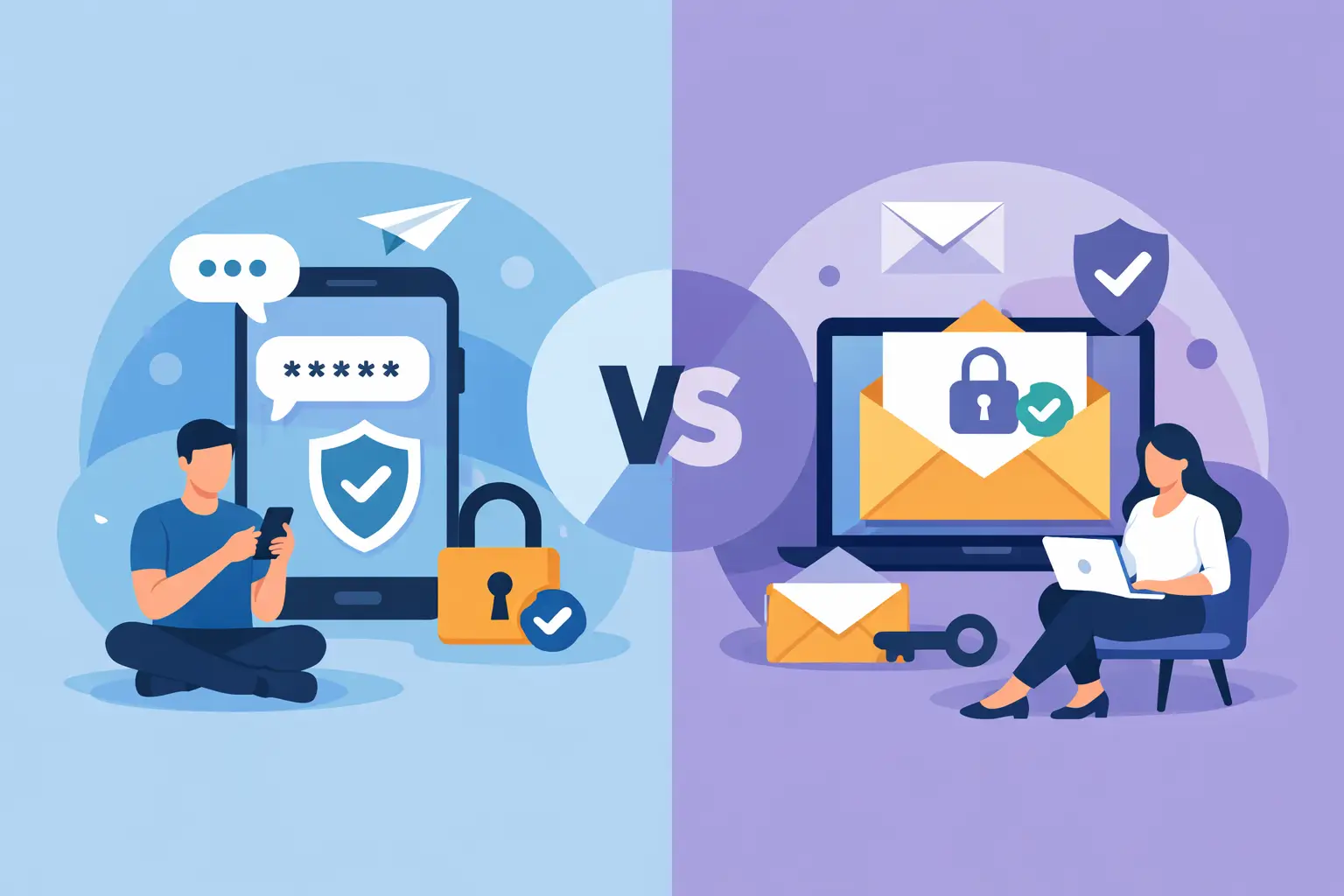
A code sent with a 30-second delay can mean an abandoned login, a lost cart, or a customer who gives up on payment. When analyzing OTP via SMS vs email, you're not just comparing two delivery channels. You're comparing speed, completion rate, exposure to fraud, and how simple it is for the user to pass verification without friction.
For many companies, the choice seems simple: email costs less, SMS seems more direct. In practice, things are more nuanced. The right channel depends on the moment in the customer journey, the level of risk, and how much an abandonment costs you.
OTP via SMS vs email: the real difference
The OTP has a single mission: to arrive quickly and be used immediately. Here is where the first major difference appears. SMS is built for instant attention. The phone displays the notification directly on the screen, and the user sees the code without opening an app, without searching through folders, and without wondering if the message landed in Promotions or Spam.
Email works well when the user is already active in the inbox and when the process is not urgent. For lower-risk password resets or secondary verifications, it may be sufficient. But for quick authentication, transaction confirmation, or real-time onboarding, small delays become costly.
That's why the discussion about OTP via SMS vs email is not just about preference. It's about operational context. If your product requires immediate reaction, SMS starts with a clear advantage.
Delivery speed and usage rate
In authentication, a few seconds matter. An OTP that arrives quickly is more likely to be entered correctly and on time. SMS frequently wins here because it is consumed almost instantly, on the device the user already has in hand.
With email, speed depends on multiple variables: servers, domain reputation, spam filters, mail client synchronization, and user behavior. Even when the message is technically delivered, it doesn't mean it's seen immediately.
For product and e-commerce teams, the difference is seen in conversion. If you have login, checkout, or account confirmation in a short flow, SMS reduces the time between request and validation. This decreases abandonment and limits support frustrations, where users say they haven't received the code, even though it exists in a secondary folder.
Security: there is no perfect channel
Many start with the idea that email is safer because it doesn't depend on the phone number. Others assume SMS is automatically safer because it arrives on a personal device. Both perspectives are incomplete.
Email is vulnerable if the user's inbox is already compromised, if the password is weak, or if there is credential reuse. Additionally, many users remain logged in permanently to their email account on multiple devices. If access to the inbox is already open, the OTP sent there doesn't add much protection.
SMS comes with other risks, such as fraudulent SIM swapping or access to the physical phone. However, for many commercial scenarios, especially number verification, quick login, and confirmation of sensitive actions, SMS remains an effective method because it ties verification to an active mobile device.
The useful truth for business is this: security doesn't just depend on the channel, but also on how you implement it. Code lifespan, attempt limitation, rate limiting, monitoring suspicious behavior, and number verification make the difference between a decent flow and a vulnerable one.
User experience decides more than you think
If you make the user switch apps, search for the email, and then return to the flow, you introduce additional steps. Each step decreases the chance of completion. On mobile, where a large portion of authentications occur today, SMS is more natural. The message appears immediately, and in many cases, the code can be copied or auto-filled.
Email is less intrusive and may be perceived as more suitable for non-urgent interactions. Some user categories prefer not to provide their phone number from the start. If your goal is a low entry barrier at account creation, email may seem more comfortable initially.
But here's where the compromise appears. Easy onboarding at the first step can lead to more fraud, fake accounts, or less useful contact data for future communications. If you need quickly validated users, SMS offers more control from the first interaction.
Cost is not measured only per message
Email is almost always cheaper in unit price. If you look strictly at the sending cost, the comparison seems closed. But an OTP shouldn't be evaluated only by the message cost, but by the cost of failed authentication, fraud, and lost users.
If a more expensive SMS increases your verification rate, reduces support tickets, and improves payment completion, the total cost per result may be better than email. For companies with large volumes, the difference between cost per message and cost per successful verification is essential.
Email makes sense when verification is not time-critical, when the user base is already active on this channel, and when operational margin demands minimal cost. SMS makes sense when each missed verification affects revenue, retention, or risk.
When SMS is the better choice
For quick login, mobile onboarding, transaction confirmations, phone number verification, and access recovery in urgent scenarios, SMS is usually the more efficient option. It is direct, hard to ignore, and suitable for actions that need to be completed in seconds.
It is also the better choice in markets where users check their phones more often than their inboxes or where your app is predominantly used on mobile. In these cases, the experience difference is large enough to justify the investment.
For companies seeking automation and technical control, delivering OTP via API infrastructure also offers a clear operational advantage. You can monitor requests, set rules, control volumes, and integrate verification directly into existing flows without cumbersome processes.
When email is sufficient or even preferable
Email remains useful for non-urgent password resets, secondary validations, and flows where the user is already working on desktop or in the inbox. It is also a good option when you want to limit costs on a large scale and the fraud risk is moderate.
It may be the right choice in products where the user is not willing to immediately provide their phone number. If you ask for too much too soon, you may lose sign-ups. In such cases, email can be the first step, and SMS verification can come later when trust levels increase or when the user initiates a sensitive action.
This is one of the most practical approaches: you don't choose a single channel for everything, but align the channel with the moment and the risk.
A smarter approach: primary and fallback
The most efficient systems do not treat OTP as a rigid decision. They treat verification as a process that must work even when one channel delays or is inaccessible. Here comes a simple and very useful strategy: a primary channel and a backup one.
You can use SMS as the main option for speed and email as a fallback when the message is not delivered or when the user prefers another method. Or vice versa, if you optimize costs and accept a slightly slower flow for certain account categories. The important thing is not to force all scenarios into the same rule.
For businesses operating in multiple markets, this flexibility matters even more. User behavior differs, as do costs or channel performance. A platform that allows you to adjust delivery logic and scale quickly makes the difference between a stable authentication process and one that creates friction at every traffic peak.
How to make the right decision for your company
Instead of asking which channel is better in general, ask what costs you more: an extra message or a missed verification. If you have a time-sensitive, fraud-sensitive, or abandonment-sensitive flow, prioritize SMS. If you have a low-urgency flow with a strong focus on cost efficiency, email can work very well.
Test the decision with real data. Measure delivery time, OTP completion rate, mobile device abandonment, support tickets, and differences between markets. That's where the correct answer appears, not in assumptions.
For many companies, the winning combination is not OTP via SMS vs email, but OTP via SMS where speed and validation matter most, complemented by email where cost and flexibility are priorities. If you want a stable, simple, and easily expandable operation, it's worth building verification as a business system, not just as a field in the form.
A good OTP should not attract attention at all. It should just arrive on time, be used immediately, and let the user move on.