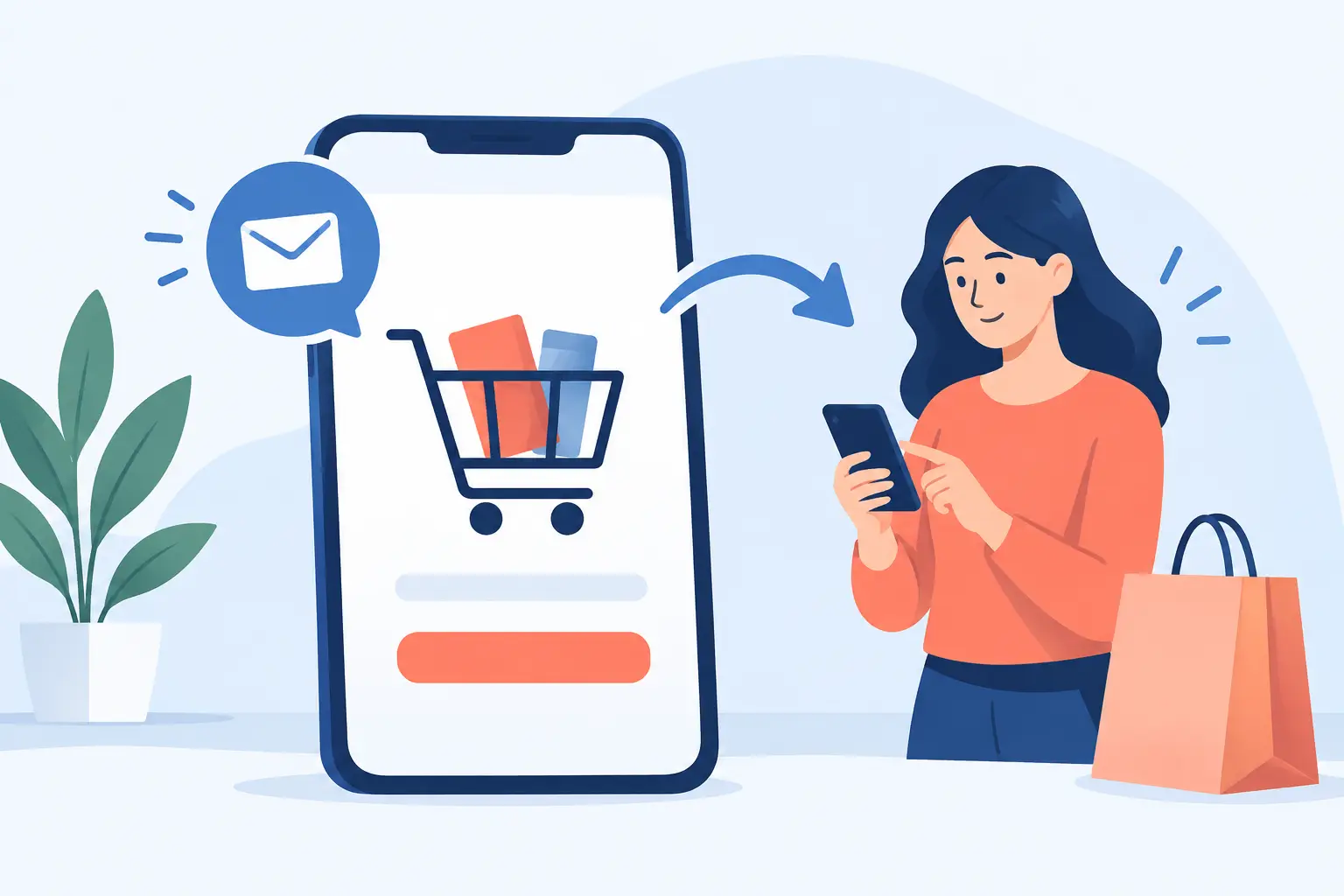
A client selected products, possibly entered the delivery address, then closed the page. It doesn't necessarily mean they no longer want to buy. They might have been interrupted, comparing options, or waiting for a better moment. SMS examples for cart recovery work because they bring the conversation back to a direct channel, seen quickly and easy to act on from the phone.
For an online store, a well-timed message can recover revenue without increasing the acquisition budget. But the result doesn't come from a discount code sent randomly. Timing, customer consent, the real value of the message, and a frictionless checkout experience after accessing the link matter.
When it's worth sending a cart recovery SMS
The SMS is effective when the customer has consented to receive commercial messages and has provided a valid phone number. It is a personal channel, and this advantage comes with a clear responsibility: the message must be relevant, identifiable, and easy to opt-out for those who no longer wish to receive communications.
Not every abandoned cart should be treated the same. For a small order, a single reminder message may be sufficient. For higher-priced products, with a longer decision process, a carefully dosed sequence might be more suitable. For example, someone who left a subscription, a personalized product, or B2B equipment in the cart may need information about warranty, delivery, or support, not just a financial incentive.
Before the campaign, check if the stock, price, and landing page are correct. An SMS leading to an out-of-stock product or an empty cart does not recover the order but reduces trust in the brand.
SMS examples for cart recovery, based on intent
The messages below are working models. Replace the fields in brackets with real data and keep the wording close to your brand's voice. A short, unique, and secure link to the saved cart reduces the steps to payment.
1. The quick reminder message
Send it 30-60 minutes after abandonment. The goal is not to pressure the customer but to eliminate forgetfulness.
“Hi, [First Name]! Your items from [Brand] are still in the cart. Complete your order here: [link]. Need help? Reply directly to this message.”
This format is suitable for consumer products, recurring orders, and brands offering two-way SMS support. The last sentence can generate useful conversations: questions about size, compatibility, delivery time, or payment methods. Ensure the team can respond within a reasonable timeframe. A two-way channel without a quick response can have the opposite effect.
2. The availability-based message
Use urgency only when it's real. Limited stock, an expiring reservation, or the deadline for a special delivery are valid reasons. Artificial formulations like “last hours” in every campaign wear out quickly.
“[First Name], the item [Product] is still available, but stock is moving fast. Your cart is ready for completion: [link]. - [Brand]”
For fast-turnover categories, this message can be more convincing than a discount. It protects the margin and offers a concrete reason for action. If stock is frequently replenished, avoid suggesting rarity.
3. The message with a clear benefit
Sometimes abandonment occurs due to unclear costs or insufficiently evident value. Instead of automatically offering a discount, remind the benefit that differentiates the offer.
“Hi, [First Name]! Your cart is saved. Today's order includes [real benefit: free shipping / easy return / gift]. Resume checkout here: [link].”
This variant is useful for stores that already have a strong competitive advantage. Free shipping over a threshold, extended return, included installation, or additional warranty can resolve the objection without eroding profitability.
4. The message with a controlled incentive
A discount code makes sense if the margin, cart value, and customer behavior justify the intervention. Don't turn the discount into a rule that customers learn to expect after every abandonment.
“[First Name], we're keeping your cart until [time]. Use code REVENI10 for a 10% discount at checkout: [link]. Valid until [date]. - [Brand]”
Set a real expiration date and exclude products or categories for which the promotion is not profitable. A good alternative is the minimum order threshold or a non-monetary benefit, like free shipping. For new customers, testing a small offer may be justified. For loyal customers who buy without incentives, a simple reminder may perform better.
5. The trust message for products with a difficult decision
For expensive or technical products, the customer may abandon because they have an unresolved question. Provide direct access to a person or the necessary information.
“Hi, [First Name]! Do you have more questions about [Product]? The [Brand] team can help you with details about compatibility, delivery, and warranty. Your cart: [link]. Reply here.”
This model is suitable for electronics, services, configurable products, and B2B orders. In such cases, the SMS's objective is not always immediate checkout. It can be opening a conversation that later leads to an order.
Timing that keeps the message useful
An effective sequence usually starts with the first SMS 30-60 minutes after abandonment, when the purchase intent is still fresh. The second message can be sent after 20-24 hours and may introduce a relevant benefit or support. If justified, a final message at 48-72 hours can communicate the real expiration of a code or reservation.
Frequency depends on the category and average order value. For impulsively bought products, three messages may already be too many. For a flow with consultancy or a complex purchase, an additional message may be acceptable if it brings new information. Automatically stop the sequence as soon as payment is confirmed. Nothing seems more careless than a recovery SMS received after the order.
Respect the recipient's local hours and avoid sending very early or late. A message can be technically delivered but commercially missed if it appears at an inappropriate time.
Personalization that increases conversion without becoming intrusive
First name and abandoned product are starting points, not the entire strategy. Useful personalization can include the product category, the store selected for pickup, the free shipping threshold, or the preferred language. Do not include sensitive data and do not transmit information in SMS that could create discomfort if the phone is seen by someone else.
Segmentation should also consider behavior. A new customer who abandoned their first order may react to clarifications about returns and payment. A recurring customer needs more speed: saved cart, direct link, available product. For customers who have already received a recent offer, avoid sending another without reason.
The message must immediately identify the sender. Include the brand name, maintain a consistent tone, and provide a clear unsubscribe option, according to the requirements of the market you are communicating in. In international campaigns, adapt the language, time zone, and consent rules for each country.
How to measure a cart recovery campaign
Do not evaluate the result only by the number of clicks. Track delivery rate, link clicks, attributed orders, recovered revenue, average order value, response rate, and unsubscribes. If using codes, also compare the total cost of discounts with incremental profit, not just gross revenue.
Test one important variable at a time: the timing of the first send, the incentive, the call-to-action wording, or the number of messages. A test where you change everything simultaneously produces results that are hard to interpret. Also, keep a control group without SMS to estimate how many orders would have been naturally recovered.
A platform like SMSense can support this flow through quick campaigns, two-way messages, and API integration with the store or automation platform. For large volumes, number validation and delivery monitoring help protect the budget and maintain a consistent experience.
The best recovery SMS is not the most insistent one, but the one that appears at the right time, resolves a real objection, and makes returning to checkout almost effortless. Start with a simple message, measure the response, and build the sequence only where data shows it helps the customer decide.