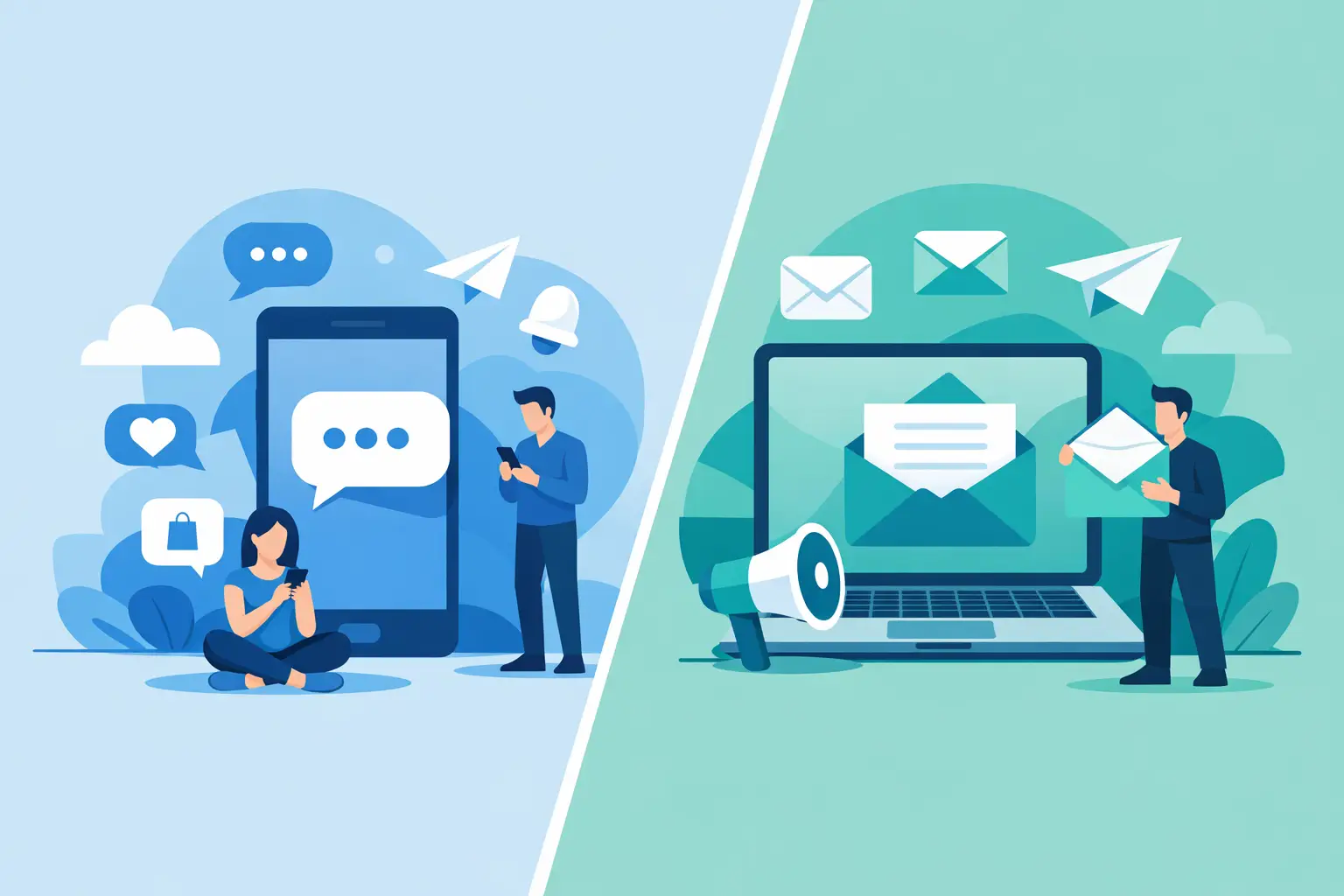
An online store sends a promotion on Friday at 6:00 PM. The email looks good, has a clean design and a clear discount, but it ends up in a crowded inbox. The SMS, on the other hand, appears directly on the screen and requires much less effort from the client. This is where the real discussion about SMS marketing versus email marketing begins: not which channel is "better" overall, but which channel produces the right result at the right time.
For marketing teams, e-commerce operators, and customer engagement managers, the choice is no longer just about cost per message. It's about speed, attention, deliverability, experience, and the type of action you want to achieve. And for companies operating at scale, it also matters how easily you can automate everything, from campaigns to notifications and transactional flows.
SMS marketing versus email marketing: the fundamental difference
Email is a richer content channel. It offers you space for images, explanations, more detailed segmentation, and more elaborate brand messages. It's suitable when you have something to present, explain, or sell in a more extensive format.
SMS is a short, direct channel oriented towards immediate action. When the message needs to be seen quickly and understood in a few seconds, SMS has a clear advantage. It doesn't require opening an email app, doesn't depend on rendering a template, and doesn't force the user to go through a lot of text.
In other words, email works well for context and detail, while SMS is for attention and quick reaction. If you're trying to sell a complex product, a well-constructed newsletter might do the job better. If you want to push a limited offer, confirm an order, or reduce cart abandonment, SMS can be much more effective.
When email wins
Email marketing remains very valuable for recurring campaigns, editorial content, onboarding, and nurturing. If you need to communicate more benefits, include more products, or build a relationship over time, email offers flexibility.
For example, an e-commerce brand can send a collection launch email with images, categories, prices, and personalized recommendations. A SaaS can use email to educate new users through automated sequences. A B2B company can send commercial follow-ups with more detailed information than would fit in an SMS.
Email is also more budget-friendly for high-volume campaigns when frequency is high. If you frequently send promotional or informational content to large databases, the cost per contact can become very attractive. But this advantage comes with a condition: messages must be relevant, otherwise they end up ignored, moved to secondary tabs, or filtered.
When SMS wins
SMS works excellently when timing matters. Flash promotions, reminders, delivery alerts, confirmations, OTP codes, number verification, and quick reactivations are examples where speed beats complexity.
A client receiving an SMS with "Your order will arrive today between 2:00 PM and 4:00 PM" sees it almost immediately and can adjust their plan. A user requesting two-factor authentication needs the code now, not in 20 minutes. A subscriber who abandoned their cart can react faster to a short, clear, and well-timed message than to an email lost among dozens of others.
For many companies, this is where the practical value of a solid messaging platform comes in: not just promotional campaigns, but also infrastructure for essential messages, with reliable delivery, API integration, and automated flows that reduce both friction and operational losses.
Client attention is not evenly distributed
One of the biggest mistakes in channel planning is assuming that a sent message is also a consumed message. It is not. Email competes with newsletters, internal notifications, commercial communications, and spam. SMS competes less, but that's why it must be used with more discipline.
When you send SMS, you enter a more personal space. This can bring you high visibility rates, but also negative reactions if you overdo it. Too frequent, irrelevant messages or those sent at inappropriate times can quickly affect brand perception. In email, you have more room to maneuver, but also more risk of being ignored.
Practically, email tolerates frequency better. SMS tolerates urgency better. If you reverse the roles, results decline.
Costs, yield, and real value
On the surface, email almost always seems cheaper. In many cases, it actually is. But if you analyze the cost relative to the desired action, things change.
If your goal is a quick read, a confirmation, a click on a limited offer, or fraud reduction through OTP and verification, SMS can have a better yield even if the price per message is higher. If the goal is awareness, education, or promoting a broader product portfolio, email can win in overall efficiency.
It's also worth considering the internal cost. Email often requires design, QA on multiple devices, deliverability settings, and longer production time. SMS is simpler to launch but requires very good copy, clear segmentation, and strict frequency control. The cost is not just technical, but also operational.
SMS marketing versus email marketing in automations
This is where the discussion becomes more interesting. The best results rarely come from exclusively choosing one channel. They come from orchestration.
An efficient flow can start with email for context and continue with SMS to accelerate action. For example, you send a product launch email in the morning, and for the segment that hasn't purchased but clicked, you send a short SMS with a limited incentive in the evening. Or you send email for onboarding, and SMS for verification, activation, and critical reminders.
The same principle applies in support and operations. Email documents. SMS mobilizes. When the two channels are connected through clear rules and clean data, the client experience becomes more coherent and efficient.
For companies that need more than promotional campaigns, it's important to work with a provider that can support both transactional messaging, 2-way SMS, verification, and technical integration without unnecessary complications. This reduces dependency on fragmented systems and simplifies execution.
Which channel to choose based on the objective
If you want traffic to a catalog, brand storytelling, or medium-term education, start with email. If you want immediate reaction, quick recovery, confirmation, or security, start with SMS.
For retail and e-commerce, SMS is very powerful in time-limited campaigns, order updates, and cart abandonment. Email remains useful for launches, cross-sell, and commercial newsletters. For SaaS and digital platforms, email helps with onboarding and retention, while SMS is excellent for authentication, account verification, and critical notifications. For local services, clinics, or companies with appointments, SMS has a clear advantage for reminders and reconfirmations.
Don't start with the channel. Start with the behavior you want to achieve.
How to avoid wrong decisions
The most common wrong decision is to use SMS only for promotions and email only for "everything else." In reality, both can support sales, retention, and customer experience, but in different ways.
The second mistake is lack of segmentation. A recurring customer who has purchased five times should not be treated the same as a cold lead. In SMS, relevance matters enormously. In email, lack of segmentation erodes performance over time. The third mistake is lack of infrastructure: unvalidated databases, poor timing, incomplete automations, and superficial reporting.
That's why fast-growing companies need more than a sending tool. They need control, good delivery, simple integration, and the option to combine marketing with operational and security messages. Here, a platform like SMSense can make sense for teams that want both quick execution and real technical capabilities.
The right choice is rarely black and white
If there were a universal winner in the SMS versus email dispute, the market would have already decided. But the reality is simpler and more useful: each channel has a clear role, and performance comes from matching the message, moment, and user intent.
Email is good when you need to convince. SMS is good when you need to move the client. And when you use them together, with logic and discipline, you get more than opens or clicks. You get a communication system that supports sales, reduces losses, and makes the client experience clearer.
If you're still choosing between the two, start with a more practical question: does your client need context or action now?