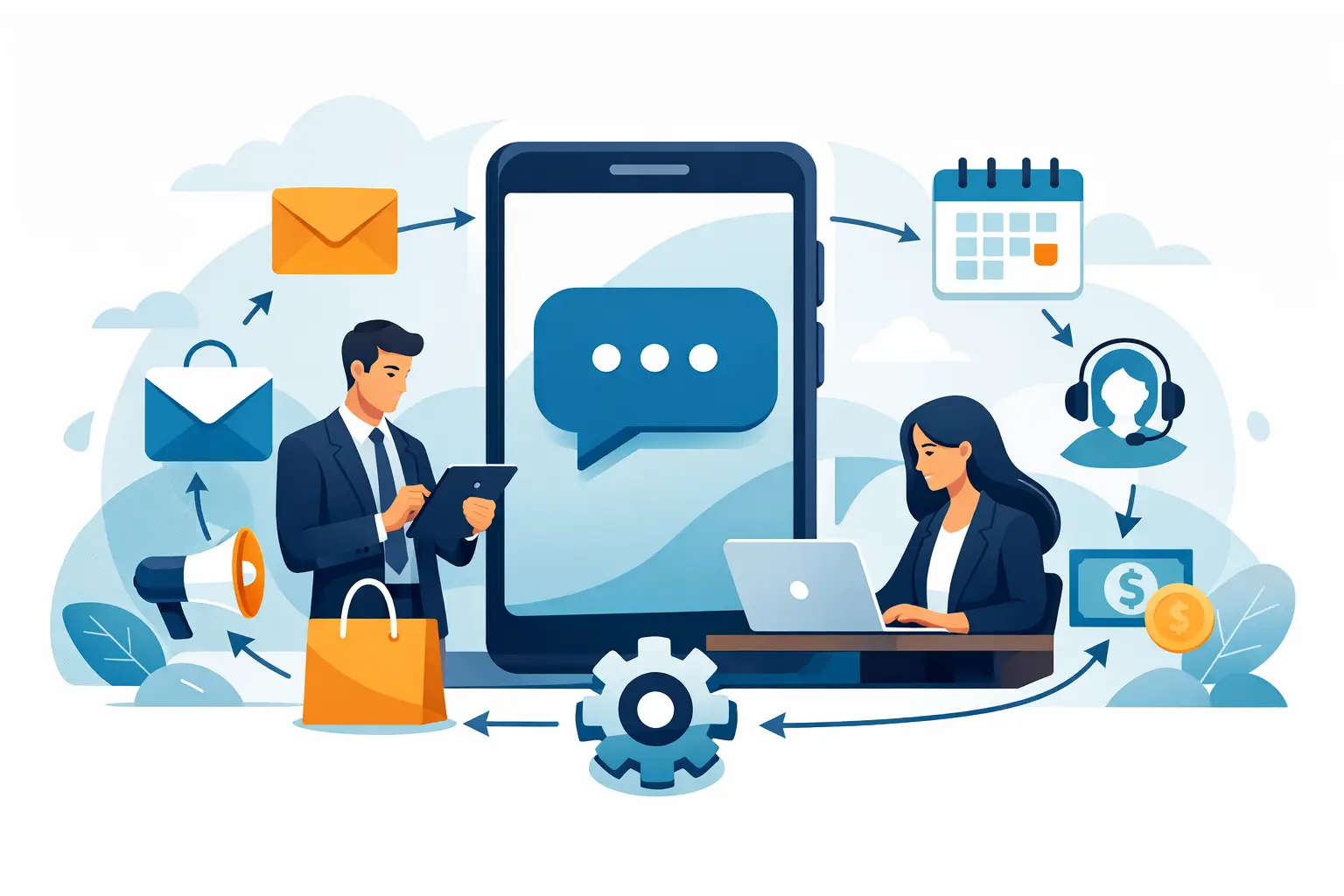
A text message read at the right time can recover an abandoned order, prevent a missed appointment, or stop a fraud attempt. The most useful SMS flows are not mass messages sent without context, but automations built around a clear customer action. For a business, the difference is simple: communicate when the information has immediate value, not just when you have something to promote.
The SMS works well because it is direct, fast, and does not depend on algorithms or the installation of an app. However, results do not come from volume. They come from relevance, correct contact data, and a logical path between the user's action, the message, and the desired next step.
How to choose the most useful SMS flows
Before setting up an automation, determine what problem it solves. An online store can lose revenue from abandoned carts. A clinic can lose time and capacity through no-shows. A digital platform may need quick number verification and authentication protection. The same channel, SMS, serves different objectives.
A good flow has three components: a precise trigger, a short message, and an easy action to take. The trigger can be an abandoned order, an upcoming reservation, a change in delivery status, or a login attempt. The message must immediately state what is happening and what the recipient can do. And the action must be proportional to the situation: confirmation, response, accessing a link, or contacting support.
Not all flows need to be activated from day one. Prioritize them based on operational and commercial impact. In many companies, transactional and security flows take priority because they respond to an immediate customer need. Then follow automations that increase conversion or reduce the team's manual work.
SMS flows that bring quick results
Order confirmation and delivery updates
After a purchase, the customer wants certainty. A confirmation message with the order number, value, and next step reduces support requests and gives the buyer confidence that the payment has been recorded. The message should be sent immediately after the event, not hours later.
Delivery updates are equally valuable. Notifications like "the order has been shipped," "the courier arrives today," or "the package is available for pickup" reduce failed deliveries and increase satisfaction. If you send a tracking link, keep the message concise and clearly indicate the sender. In this flow, utility is more important than the promotional component.
Recovering abandoned carts
An abandoned cart does not always mean a lack of interest. The customer may be interrupted, comparing options, or have a question about shipping. An SMS sent 30-60 minutes after abandonment can bring the user back into the buying process while the intention is still fresh.
Do not turn the message into commercial pressure. Remind the product or category, offer a direct link to the cart, and, if justified by margin, a limited incentive. For example, a discount code may work for a new customer but is not necessary for every abandonment. If you lower the price too quickly, you can educate your audience to always wait for an offer.
Reminders for appointments, reservations, and payments
For services, missing an appointment has a concrete cost: lost time, underutilized staff, and slots that can no longer be filled. An SMS reminder sent 24 hours before, sometimes followed by one on the day of the appointment, can significantly reduce no-shows.
The message should include the date, time, location, or access instructions and a simple method of confirmation or rescheduling. For salons, clinics, auto services, consultants, or event organizers, the response via SMS can be faster than a call. If there is integration with the scheduling system, the client's status can be updated automatically, without team intervention.
The same principle applies to due payments. A polite notification before the deadline, followed by a message after the due date, can reduce delays without the financial team manually tracking each case. The tone matters: clear and firm, but without wording that can damage the commercial relationship.
OTP codes and phone number verification
Fake registrations, duplicate accounts, and account takeover attempts are real risks for any digital product. An OTP code sent via SMS confirms that the user controls the declared number and provides a quick step for authentication or validation of a sensitive operation.
Here, delivery speed and message clarity are critical. The code must be visible in the first words, and the message should state what action it is used for and how long it remains valid. Do not include sensitive information in the text and never ask the user to forward the code. An efficient message can simply say: "Your verification code is 482913. Valid for 5 minutes. Do not share it with anyone."
To limit fraud and unnecessary costs, companies can combine verification with intelligence data for numbers. HLR lookups can help confirm the availability of a number, and MNP data can identify number portability and the current network. The choice depends on the market, volume, and accepted risk level.
Account notifications and security alerts
A client should not find out too late that their password has been changed, a new device has been added, or a payment has been declined. SMS alerts provide immediate visibility on events that require attention. In many situations, they reduce reaction time and requests to support.
Avoid vague messages like "suspicious activity." State what happened, without exposing private data, and offer a safe action: "A new login to your account was detected. If it wasn't you, reset your password from the app or contact support." For high-risk flows, the message can be accompanied by internal rules to limit attempts and additional authentication.
Feedback after relevant interactions
Requesting feedback works when the experience is still fresh. After delivery, resolving a ticket, or completing an appointment, an SMS with a very short question can collect useful signals about service quality. Do not ask for a long questionnaire in a channel created for speed.
You can start with a numeric response or a simple choice, then direct clients who had a poor experience to the support team. Thus, feedback does not remain a monthly report but becomes an intervention mechanism. For satisfied clients, the same automation can request a review, but only if the relevant platform's regulations and policy allow it.
The timing of sending changes performance
Even the correct message can have poor results if sent at the wrong time. Transactional messages are sent immediately after the event because their value depends on timeliness. Commercial messages should be scheduled according to time zone, audience behavior, and industry specifics.
For a B2C store, a promotional message early in the morning or late at night may seem intrusive. For a B2B business, a notification during working hours may be more appropriate. Test sending times, but do not evaluate only the click rate. Track conversion, responses, unsubscribes, and impact on revenue or request volume.
Frequency must be controlled at the client level, not just at the campaign level. A person may receive an order confirmation, a delivery alert, and a promotion in one day. The first two are useful, but the third message may be excessive. Frequency limitation rules and prioritization of transactional messages protect the client experience.
Clean data, consent, and integration
A high-performing SMS flow starts with a correct database. Format numbers in the international standard, eliminate duplicates, and update consent statuses. Do not send marketing messages to people who have not given their consent and provide a clear method of unsubscribing where applicable legislation requires it. Requirements differ between countries, so checking local rules is part of implementation, not an administrative detail.
Integration between the store, CRM, ticketing system, scheduling platform, or digital product determines how useful the flow becomes. If data flows slowly between systems, messages may arrive with delays or incorrect information. For teams without large technical resources, contact imports and scheduled campaigns can cover basic needs. For digital products and large volumes, API integration allows automatic triggering of messages exactly at the desired event.
SMSense can support both scenarios, from campaigns managed directly on the platform to transactional messaging, OTP, and API-connected flows. The important thing is for the implementation to be measured by a concrete objective, not just by the number of SMS sent.
Start with a flow that solves a visible problem
It is not necessary to automate every stage of the customer relationship. Choose a point where delay, lack of information, or manual work already incurs costs: order confirmations, appointment reminders, cart recovery, or access security. Configure the message, define the trigger event, and track the result for a few weeks.
When the client receives the information exactly when they need it, SMS is no longer just a promotional channel. It becomes a useful part of the experience offered by your business.