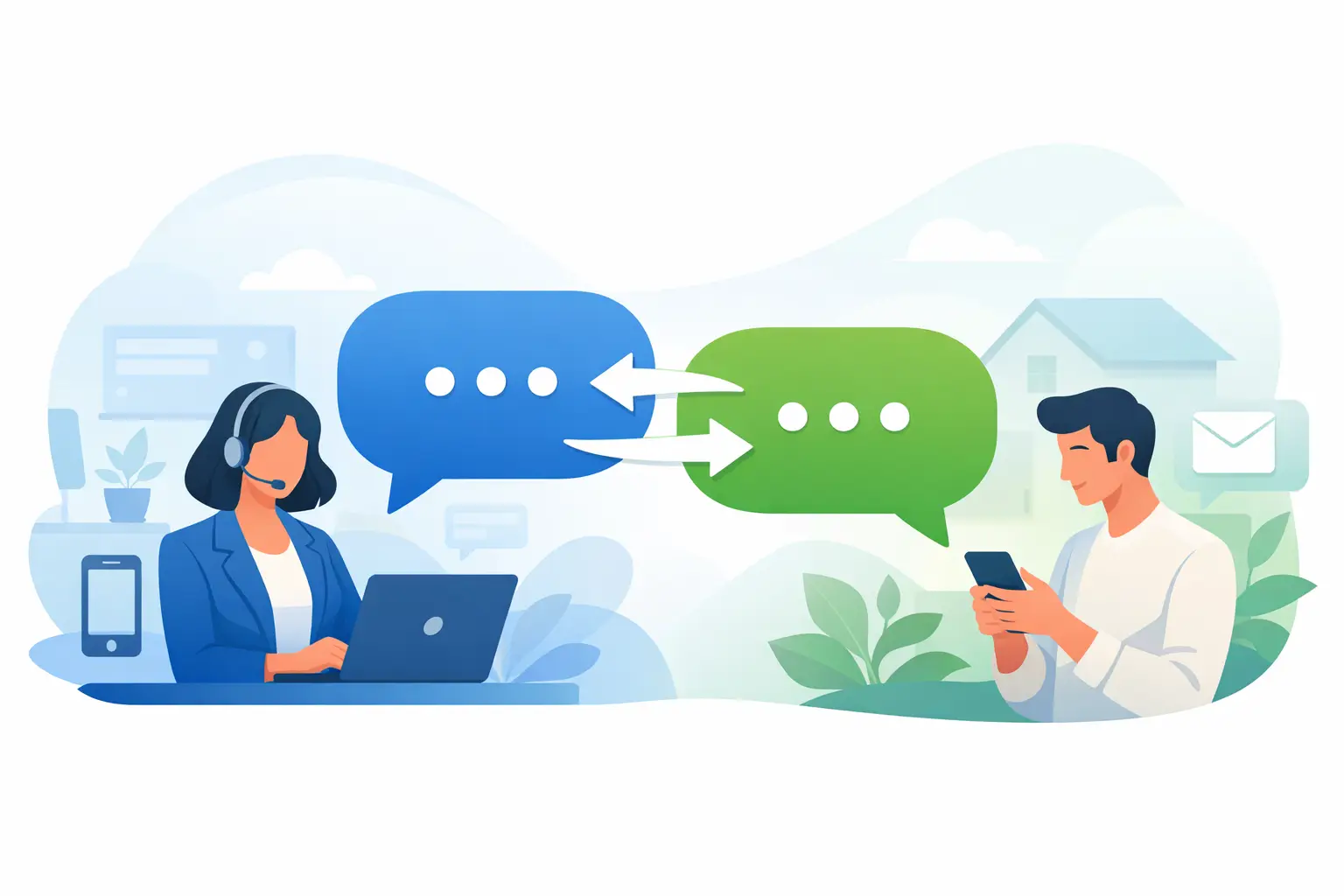
A client responds to your message with a simple "Yes" or "No," requests details about an order, or confirms an appointment in seconds. This is where the real value of a two-way SMS system for clients is evident: you don't just send notifications, you open a conversation that can accelerate sales, reduce pressure on support, and provide a much clearer experience.
For many companies, SMS has remained stuck in a one-way model: promotions, alerts, confirmations. It's useful, but limited. When the client can't respond directly, the next step usually becomes harder - a call, an email, a form, or a missed interaction. Two-way communication solves exactly this gap.
What two-way SMS for clients means in practice
With two-way SMS for clients, the company sends messages, and the recipient can reply on the same conversation thread. It's not just a technical feature. It's a process change. Instead of treating SMS as a broadcast channel, you use it as an operational and commercial channel.
This is especially important for teams working with large volumes of interactions. An online store can quickly confirm an order change. A clinic can receive appointment confirmations. A support team can handle short questions without moving the client to another channel. For developers, the model is equally valuable because it can be integrated into automated flows via API, routing rules, and delivery statuses.
Why it works better than one-way SMS
SMS already has a clear advantage: it is read quickly. The two-way part adds what is often missing in client communication - immediate response. When you ask the client to take a simple step directly in the message, you reduce friction. When you force them to change the channel, you lose speed and often intent.
For business, the benefit is not just "engagement." It's measurable efficiency. Confirmations received via reply can reduce no-shows. Short questions resolved via SMS can reduce call center calls. Responses to campaigns can indicate real interest and can fuel better segmentations or follow-ups.
There is also a control advantage. In email, opening does not guarantee action. In telephony, each interaction costs operator time. In two-way SMS, a large volume of short conversations can be partially automated, intelligently prioritized, and transferred to agents only when necessary.
Where it makes the most sense
Not every company needs long conversations via SMS. The channel works best when messages are short, clear, and action-oriented.
Confirmations and rescheduling
This is one of the best use cases. You send an appointment confirmation, and the client replies with "1" for confirmation or "2" for rescheduling. Simple for the client, efficient for the team, easy to automate.
Fast operational support
If a client asks where the order is, if the product is in stock, or if they can change the delivery time, it doesn't make sense to push them immediately to the call center. For simple requests, an SMS reply can quickly close the case.
Lead qualification and follow-up
After a campaign, you can ask for a short response: "Are you interested in a personalized offer?" or "Do you want a consultant to call you?". This helps the sales team focus on contacts that truly have intent.
Security and verification
In some flows, two-way messages complement authentication or verification processes. They don't replace OTP where strict security is needed, but they can support action validation, request confirmation, or exception clarification.
What you need to set up before implementation
Many projects fail not because the technology doesn't work, but because the process behind it is vague. If you open a reply channel, you need to know who responds, in what time frame, and under what rules.
The first step is to define the types of conversations you want to receive. If you send promotional campaigns, you can expect questions about price, stock, delivery, or unsubscribe. If you send transactional notifications, the replies will be more about changes, confirmations, and exceptions.
The second step is to decide what you automate and what you escalate to humans. Some responses can be handled by simple rules. If someone sends "STOP," the flow must automatically respect communication preferences. If someone writes "I want to change the address," the case can go to support. The difference between a useful system and a chaotic one lies in this separation.
The third step is about visibility. You need a simple dashboard or integration into existing systems so the team can see messages, statuses, and history. Without this, replies become just another ignored inbox.
Two-way SMS for clients and API automation
For companies that send messages at scale, the technical part becomes decisive. A two-way SMS system for clients should allow receiving replies via webhook or API, mapping them to accounts, orders, or tickets, and automatically triggering actions.
Here are some important differences between basic platforms and those oriented towards serious operations. It's not enough to be able to send and receive messages. You need stable delivery, clear reporting, predictable routing, and options for variable volumes. If you already use OTP, number verification, HLR lookup or other messaging services in a single infrastructure, you save time and reduce integration complexity.
For non-technical teams, the value comes from the same idea, but in a simpler form: quick contact upload, easy-to-launch campaigns, and messages that clients can actually respond to. For developers, control matters. For marketing and support, response time and flow clarity matter.
What results you can track in practice
If implemented correctly, the impact is seen quite quickly. Not just in response rate, but also in operations.
You can track the number of confirmations received, the average time to the first response, the percentage of conversations resolved without a phone call, the reduction of no-shows, and the number of leads qualified through reply. In e-commerce, it's worth tracking deliveries saved through quick communication. In services, managing rescheduling without extensive manual intervention is significant.
However, results depend on context. If your messages are too general, too frequent, or sent at inappropriate times, responses will decrease. If you promise conversation but the team responds after a day, the experience deteriorates. The channel works well when there is relevance, speed, and clear rules.
Real limits and compromises
It should be said directly: two-way SMS is not the ideal solution for every type of support. If the issue requires long explanations, images, documents, or complex steps, another channel will be more suitable. Similarly, if your client base strongly prefers chat applications, SMS may play a more complementary role.
There is also the compliance and cost component. You need to manage consent, opt-out options, and local sending rules. Additionally, if you open large-scale replies without automation or without a prepared team, operational costs can increase. In other words, two-way doesn't automatically mean efficient. It becomes efficient only when well orchestrated.
How to start without complicating the project
The best approach is a limited but clear one. Choose a single use case that has a direct impact. For example, appointment confirmation, delivery updates, or follow-up after leads. Write short messages with simple responses and clear expectations.
Then establish three things: who receives the replies, what happens automatically, and how quickly an agent intervenes if the message requires human attention. If you can integrate data into CRM, helpdesk, or your application, even better. If not, start with a centralized interface and simple rules.
For companies that want fast launch speed, it's worth having a platform that combines campaigns, transactional messaging, and API infrastructure in the same place. This reduces the time between testing and production. SMSense is relevant precisely in this type of scenario, where you need both simplicity for business teams and technical control for more advanced flows.
When the client can respond immediately, your message is no longer just a notification. It becomes a real point of contact, and this changes how confirmations come in, how requests are resolved, and how quickly your team moves. If you want more than just message delivery, start with a conversation that can truly go both ways.