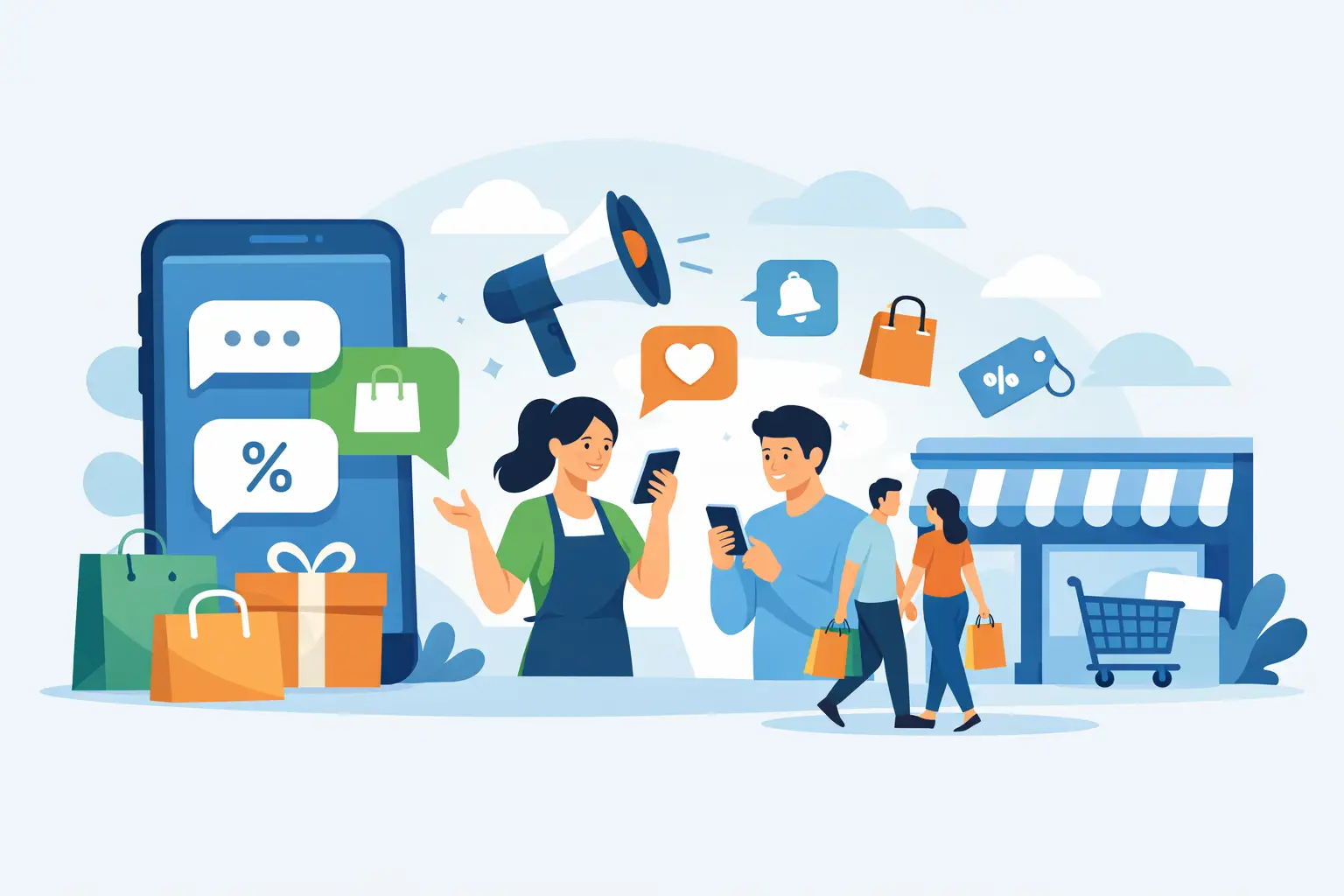
A customer who walked past the store yesterday doesn't need another generic message about "the best deals." They need a concrete reason to return today: a product they were tracking, a benefit valid for them, or useful information before reaching the checkout. The best SMS ideas for retail start here: relevance beats volume, and the timing of sending is as important as the discount offered.
The SMS can support in-store traffic, online orders, product pickup, loyalty, and post-sale services. With a fast reading rate, it is an efficient channel for communications that require immediate action. However, results appear when messages are segmented, clear, and sent only to people who have given their consent to communicate.
SMS Ideas for Retail That Support Sales
1. Limited Offer for Nearby Customers
For physical stores, a short-term offer can turn interest into a visit. The message must state exactly what the customer receives, where they can use the offer, and until when it is valid.
Example: "Only today, between 4:00 PM and 8:00 PM: 15% off seasonal footwear at our store in the Old Town. Show this SMS at checkout."
Do not send the same campaign to the entire database if the offer is available in a single location. Segment by city, preferred store, or postal code. This way, you reduce irrelevant messages and avoid frustrating customers who are too far away.
2. Stock Alert for Tracked Products
A product back in stock is one of the strongest communication opportunities. The customer has already expressed intent, and the SMS eliminates the delay between restocking and ordering.
Example: "The product you were waiting for is back in stock: Urban Fit jacket, size M. Limited stock. Order or reserve now."
The message works best when it includes the actual product name, the relevant variant, and, if possible, the store where it can be found. For large volumes, automation via API allows sending the alert as soon as the stock becomes available.
3. Personal Code for First Order
A new SMS subscriber should not be greeted with a flood of promotions. A simple and easy-to-use welcome offer creates the first purchase incentive.
Example: "Welcome! Use code START10 for 10% off your first order of at least 200 lei. Valid for 7 days."
Set a minimum cart value when the margin requires it. A discount without a threshold can increase the number of small orders, but not always profitability. Test the percentage, fixed value, and validity period before extending the campaign.
4. Messages for Abandoned Carts
In e-commerce, cart abandonment does not necessarily mean a lack of interest. The customer may be interrupted, comparing products, or waiting for delivery confirmation. An SMS sent in a short interval can bring the order back into the flow.
Example: "You left products in your cart. Complete the order by 10:00 PM and get free delivery for this order."
Do not turn cart recovery into repeated pressure. A reminder message and, in some cases, a second message with a clear benefit are sufficient. If the person does not react, it is more effective to include them later in a campaign based on the category of interest.
5. Campaigns Before Buying Periods
Retail has predictable moments: seasonal changes, holidays, back to school, Black Friday, or weekends with high traffic. Preparation begins before the audience is saturated with promotional messages.
Example: "Get ready for the weekend: the fall collection is available from Thursday. SMS subscribers have early access 24 hours in advance."
Early access does not always have to be a discount. It can mean priority reservation, choosing sizes before launch, or access to a limited collection. Exclusive advantages protect the margin and increase the perceived value of the subscription.
6. Invitations to In-Store Events
The opening of a location, a product demonstration, a consultation session, or a local launch can benefit from SMS due to the immediate nature of the channel. For events, proximity and clarity are essential.
Example: "Saturday, 11:00 AM-3:00 PM, join us for live demonstrations and free consultation at the AFI store. The first 50 people receive a gift."
The message must have a single action: participation. If you add an offer, catalog, contest, and multiple conditions, the customer will retain less. Send the initial invitation a few days before and a reminder on the morning of the event only to those in the relevant area.
7. Confirmations for Click and Collect
Operational messages are not just an obligation to inform. They reduce support calls, decrease waiting time, and build trust in the shopping experience.
Example: "Your order #48291 is ready for pickup at the Unirii store. We await you until May 18th, at 8:00 PM. You only need the order number."
After the pickup period expires, send a polite reminder before cancellation. For reserved items or limited stock, this automation can quickly bring the product back into availability for other buyers.
8. Recommendations After a Purchase
The sale does not end at payment confirmation. A message sent after delivery or after a reasonable period of use can support the next purchase if the recommendation makes sense.
Someone who bought a coffee maker can receive information about compatible filters or coffee. Someone who bought shoes can receive an offer for maintenance products. Example: "Complete your order: until Sunday you have 10% off accessories compatible with the recently purchased product."
Avoid automatic recommendations based only on popular products. Data on category, price, size, and purchase history make the difference between a useful suggestion and an ignored message.
9. Rewards for Loyal Customers
Customers who buy frequently do not always need large coupons. Often, recognizing the status and access to benefits can be more effective than a promotion available to everyone.
Example: "Thank you for choosing our store 5 times this year. You have access to free shipping for your next order, until the end of the month."
Define the rule clearly: number of orders, cumulative value, or loyalty points. If the benefit is hard to understand or requires explanations at checkout, the campaign will generate questions and lose impact.
10. Reactivating Inactive Customers
A segment of customers who have not purchased for several months deserves a different approach than that used for active subscribers. Start with the relevance of the last purchased category, not with a generic discount.
Example: "It's been a while since your last order. We've added new products in your favorite category. Return by Sunday and get 25 lei off orders over 250 lei."
A larger discount may be justified for customers with high historical value. For those who have not interacted for a long time, first check the quality of the database. Validating numbers and removing inactive contacts help control costs and better delivery.
11. Updates on Orders and Delivery
Customers most often ask where the order is and when it arrives. Transactional messages provide the answer before the person contacts support.
Example: "Order #48291 has been handed over to the courier. We estimate delivery tomorrow, between 10:00 AM and 2:00 PM. You will receive a notification if the interval changes."
These SMS messages should be separated from marketing campaigns, both in internal flows and communication agreements. Confirmations, unique passwords, and security alerts need priority and consistent delivery, especially when volume increases.
12. Feedback Requests at the Right Time
Feedback is more useful when it arrives close to the evaluated experience. After pickup, delivery, or an in-store interaction, a very short message can bring relevant responses.
Example: "How was your shopping experience? Reply with a rating from 1 to 5. Your opinion helps us improve the service."
For low ratings, create a follow-up flow to the support team. Do not ask for a review to be published before understanding the problem. A quick response can recover the customer relationship and signal repeated blockages in the store or delivery.
How to Turn Messages into Effective Campaigns
A retail SMS has limited space and competes with many other notifications. Put the benefit at the beginning, use a concrete term, and explain the required action. "Big discount" is vague. "20% off care products, until Friday, with code CARE20" is easy to understand and measure.
Segmentation should start from behavior: preferred store, city, last purchase, cart value, interest in a category, or order frequency. The more specific the campaign, the more you can limit unnecessary sends. A retailer with thousands of contacts does not need an identical message for every customer.
Frequency depends on category, seasonality, and consent. A brand with daily offers can communicate more often than a furniture retailer, where the purchase decision is rare and slower. Monitor unsubscribes, responses, code usage, and generated sales, not just the delivery rate.
A platform like SMSense allows marketing teams to launch campaigns from segmented lists, and technical teams to automate notifications via API. This separation is useful: promotions can be commercially planned, and critical messages about orders, verifications, or unique passwords can run in secure and controlled flows.
Before sending, check the customer's consent, sender identity, local rules, and clear unsubscribe option for commercial messages. Meeting these requirements is not just a matter of compliance. It's how you keep the channel credible for people who choose to receive your messages.
A good SMS does not try to sell the entire store in a single sentence. It offers the customer a precise reason to act now, then lets the shopping experience confirm the promise.