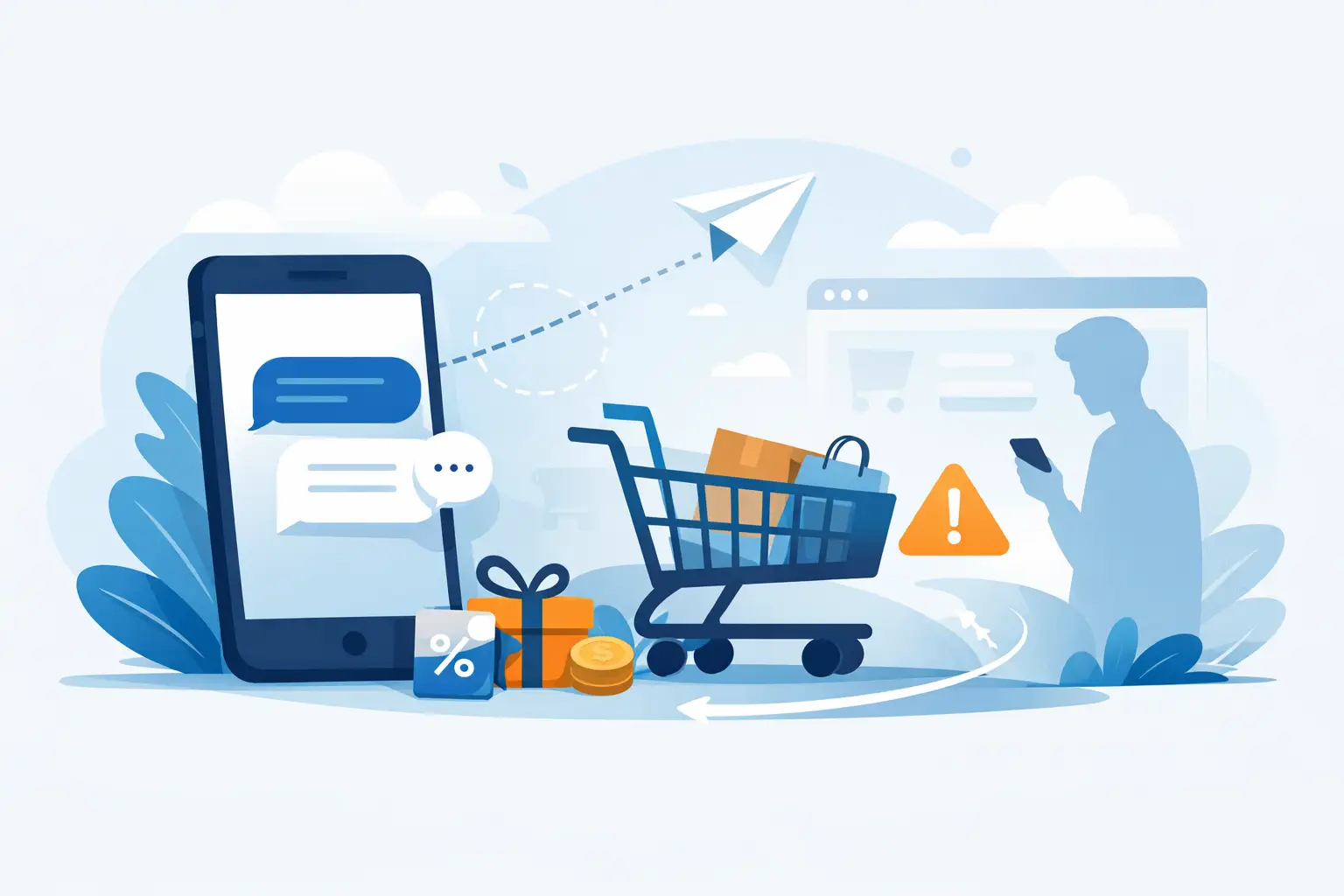
A customer enters the site, adds products to the cart, gets close to payment, and then disappears. Not because they are not interested, but because they were interrupted, compared prices, or postponed the decision. This is exactly where a cart abandonment recovery SMS can make the difference between a lost sale and a completed order.
Email remains useful, but SMS has a simple advantage: it is read quickly. For online stores that want clear results, without complicated flows and without waiting hours or days for the message to be noticed, SMS is one of the most direct recovery channels. The condition is to use it correctly.
Why a cart abandonment recovery SMS works
When someone abandons the cart, the interest is already there. We are no longer talking about awareness, but about a customer who got close to conversion. This completely changes the logic of the message. You don't have to convince from scratch. You need to reduce friction.
SMS works well in this context because it intervenes quickly and requires little effort from the customer. The message is short, personal, and appears in a space that people constantly check. If you send it at the right time, it doesn't seem aggressive, but helpful.
There is another important reason. Cart abandonment doesn't have a single cause. Sometimes the customer forgot. Other times the shipping seemed too expensive. Sometimes they were interrupted or wanted to return from another device. A good SMS doesn't assume it knows the exact reason. It creates a simple way back.
When you send the message matters more than you think
Many campaigns lose money not because of the text, but because of the timing. If you send it too quickly, the message can seem intrusive. If you send it too late, the purchase intent cools down.
In most cases, the first SMS works well 30 minutes to 2 hours after abandonment. It is the interval in which the customer still remembers the products and doesn't feel like they are being followed. For certain industries, such as fashion or beauty, a message sent on the same day can perform very well. For more expensive products, where the decision takes longer, a second reminder after 24 hours may make sense.
Here comes the important nuance: not every cart deserves the same sequence. If the cart value is low, a single clear message may be enough. If we are talking about a large cart or recurring customers, a two-step automation is worth it. Segmentation makes the difference between efficiency and spam.
How to write an SMS that recovers the cart, not just reminds it
An effective message doesn't sound like a generic ad. It should seem relevant to the customer's recent action and quickly lead them back to checkout. The less effort you ask for, the higher the chance of conversion.
The right tone is direct, calm, and utility-oriented. You don't need exaggerated formulations or artificial pressure. The customer already knows what they left in the cart. Your role is to remind them and eliminate the reason they didn't complete the order.
A good SMS usually includes three elements: context, benefit, and action. For example, you remind them that they have products left in the cart, offer a short reason to return now, and direct them straight to completion.
Messages like "You forgot something in your cart" can work but quickly become banal. It's better to go for specific and clear formulations, such as: "Your products are still available. Complete the order now while the stock is active." If you want to stimulate the decision, you can add a real advantage, such as free shipping or a limited discount. If you don't have a real offer, don't invent urgency. Customers immediately sense the difference.
What offers work well in recovery campaigns
Not every abandoned cart needs to be recovered with a discount. This is one of the most costly mistakes. If you automatically offer a discount to everyone, you teach customers to intentionally abandon and wait for the incentive.
In many cases, the first SMS should be without a discount. A simple reminder can recover a significant portion of orders. Only the second message, if you use it, can include an additional benefit. Even then, the benefit doesn't have to be a percentage discount. It can be free shipping, fast delivery, reserving the stock for a short time, or a small bonus on the order.
The choice depends on margin, product category, and customer behavior. For high-value carts, a moderate incentive can have a good return. For impulse-bought products, sometimes the speed of the message matters more than the offer.
Good automation means simple rules and clean data
A cart abandonment recovery SMS flow doesn't have to be complicated to be effective. On the contrary, the best results often come from simple, well-defined automations. When a customer reaches a certain point in the checkout, enters their phone number, and doesn't complete the order within a clear interval, the system can automatically trigger the message.
The key is to work with clean data. If the numbers are not validated, if the segments are chaotic, or if messages go to users who have already completed the order, the experience is immediately ruined. Here, the technical infrastructure matters, not just the copy. Number validation, exclusion logic, and real-time updated statuses reduce costs and protect the customer experience.
For teams that want control and speed, a platform like SMSense can help by combining SMS campaigns with automations and API integration, without cumbersome implementation processes. This matters especially when you want to scale without losing operational precision.
Examples of messages that sound good in practice
The ideal formula differs from one store to another, but the principles remain the same. A good message might sound like this: "Hi, you left products in your cart. You can quickly complete them here. If you still need them, the stock is still available."
If you want to add an incentive, the message can be more result-oriented: "Your cart is waiting for you. Complete the order today and get free shipping. Come back now and finish the order in a few seconds."
For premium products or slower decisions, the tone can be less urgent and more consultative: "You are one step away from ordering. If you want to continue, the selected products are still in your cart and can be completed immediately."
The important observation is that all these examples are short, clear, and easy to understand at first reading. That's exactly how an SMS should be.
Common mistakes in recovery campaigns
The most common mistake is sending too many messages. If you insist, the opt-out rate increases, affecting both the brand and the channel's performance. In most cases, one or two SMS are enough.
The second mistake is the lack of context. A message that just says "Take advantage now" doesn't say anything useful. The customer needs to immediately understand why they are receiving that SMS.
The third problem is the lack of segmentation. A new customer, a recurring one, and one who abandoned a very large cart should not be treated identically. If the messages are too general, you lose the very advantage of SMS: relevance.
There is also the compliance part. Consent for communication and respecting contact preferences are not administrative details. They are the basis of a strategy that can grow healthily.
How to measure if your strategy is actually generating revenue
The click rate is useful, but not enough. For a cart abandonment recovery flow, the indicator that truly matters is the recovered revenue. Look at how many orders were completed after the message, their value, the total cost of sending, and the differences between segments.
It's worth testing text variants, sending times, and types of offers, but without excessively complicating the analysis. If you change too many variables at once, you no longer know what worked. Start with simple tests: reminder without discount versus reminder with incentive, sending at 30 minutes versus 2 hours, more direct messages versus more benefit-oriented messages.
Over time, you will see where your customers react better. Some stores find that urgency based on stock converts better. Others notice that free shipping beats the discount. There is no universal rule. There are only good data and consistent execution.
Cart abandonment recovery SMS in a broader strategy
SMS should not be viewed in isolation. It works best as part of a coherent communication system, where each channel has its role. Email can provide more context, remarketing can support recurrence, and SMS intervenes exactly when speed matters.
That's why recovery messages need to be integrated with the e-commerce platform, audience rules, and exclusion logic for completed orders. When these pieces are correctly placed, SMS becomes a performance channel, not just a mass-sent reminder.
If you have constant traffic and abandoned carts every day, don't ask if it's worth testing SMS. The better question is how much revenue you are already leaving on the table without a well-constructed flow. With the right message, sent on time, and supported by a secure infrastructure, recovery starts to resemble less luck and more a controllable process.