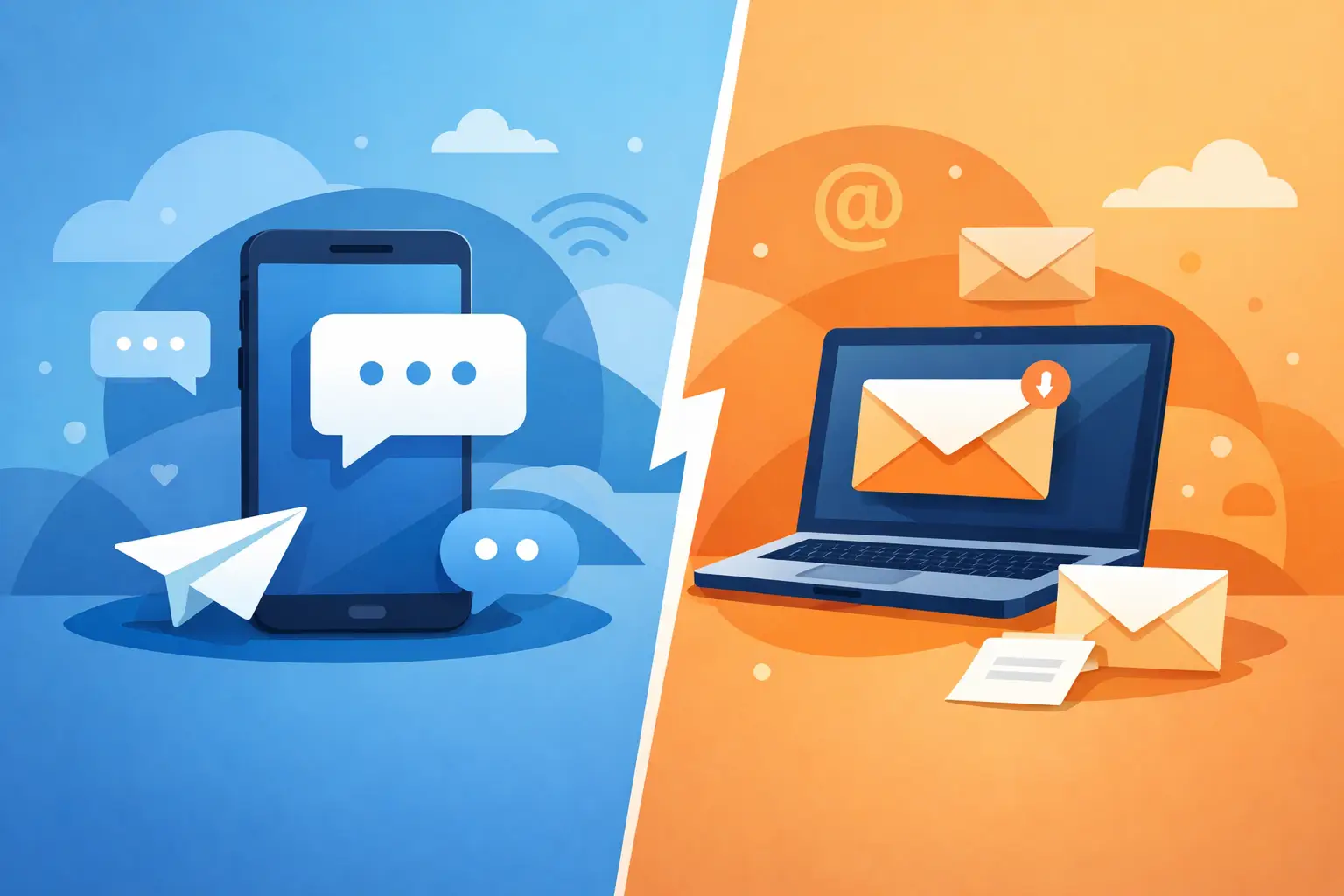
A client just paid an order, requested a password reset, or needs to know that the delivery arrives today. In these moments, choosing between transactional SMS vs email is not a marketing preference. It is an operational decision that influences trust, the volume of support requests, and the completion rate of important actions.
Both channels have a clear role. Email offers space for details, documents, and visual identity. SMS delivers short, urgent information that is easy to see directly on the phone. Companies that use the right channel for each message achieve faster communication, better-controlled costs, and simpler experiences for customers.
What does a transactional message mean?
A transactional message is triggered by an action, a request, or a concrete event. The customer expects to receive it because it is directly related to their account, order, payment, or security. Examples include OTP codes, order confirmations, delivery updates, payment alerts, security notifications, and phone number verification messages.
The transactional message should not be confused with a promotional campaign. “Your order has been shipped” is an operational message. “You have a 20% discount on your next order” is marketing. The difference matters for relevance, customer expectations, and consent rules applicable in the markets where you communicate.
Transactional email and transactional SMS can convey the same event, but they do not offer the same experience. An email can include the invoice, ordered products, delivery address, and contact details for support. An SMS can quickly say: “Your verification code is 482916” or “The courier delivers today between 2:00 PM and 4:00 PM.”
Transactional SMS vs email: the comparison that matters
Speed and visibility
SMS is built for urgency. The message reaches the phone and, in many situations, is seen without the user opening an app or searching in a crowded inbox. For authentication codes, fraud alerts, password changes, or updates that require a quick reaction, this speed is a direct advantage.
Email is less suitable when every second counts. It can be filtered, delayed, or overlooked among commercial messages. However, for information that does not require immediate action, this pace is perfectly acceptable. The complete confirmation of a reservation or the invoice of an order does not need to be read necessarily in the first 30 seconds.
Amount of information
An SMS works best when it is concise. The message must convey a single essential piece of information and, if necessary, a clear next step. The longer the text becomes, the more clarity decreases and the cost increases, depending on length and delivery market.
Email allows for context. You can include images, order details, terms, documents, instructions, and support information. It is the right channel for complex confirmations, contracts, invoices, reports, or messages that need to be kept and consulted later.
Cost and scaling
At high volume, email is generally more cost-effective from the perspective of cost per message. It is a logical choice for detailed updates sent frequently to a large customer base. But the real cost does not end at the sending price. If a critical email is missed and generates support calls, cart abandonment, or failed authentication attempts, the initial savings can quickly disappear.
SMS has a higher unit cost but can produce greater value for critical events. A payment alert seen immediately can reduce fraud. A quickly delivered OTP can increase the activation rate. A delivery notification can reduce the number of questions about the order. The correct evaluation compares the message cost with the operational impact of the missed message.
Trust and security
For authentication and account verification, SMS offers a direct path to a device associated with the user. It is not the only security mechanism and should not be treated as an absolute guarantee, but it is a practical channel for OTP, number verification, and alerts about unusual activities.
Email remains useful for traceability and complete notifications. For example, after a password change, an SMS can instantly signal the event, while the email can explain the time, device, and steps to follow if the action was not authorized. Together, the two channels offer quick reaction and context.
When to use SMS
Choose SMS for time-sensitive information, easily understood in one sentence, and relevant to a single customer. OTP codes, payment confirmations, fraud alerts, password resets, scheduling changes, and same-day delivery updates are strong cases.
SMS is also effective when the customer needs to act immediately. A clinic can reduce no-shows with an appointment reminder. A financial platform can warn about a suspicious transaction. An online store can quickly confirm that the payment was accepted. In each situation, speed reduces uncertainty.
However, do not turn every notification into an SMS. A too frequent flow becomes intrusive, increases costs, and can lead customers to ignore messages that really matter. Prioritize high-impact events.
When email is the better choice
Use email for messages that require explanations, archiving, or documentation. Detailed order confirmations, invoices, term changes, activity reports, and onboarding communications are suitable examples. The customer can return to the email when they need the information, without the pressure to react immediately.
Email is also the natural channel for educational or commercial content with multiple elements. If you want to explain the benefits of a product, present multiple options, or offer a user guide, the available space and formatting are clear advantages.
For an online order, an efficient structure can be simple: send SMS when the payment is confirmed or the package is near delivery, then use email for the complete order summary, invoice, and return information.
Do not choose a single channel for all messages
The correct question is not always “SMS or email?”. For many companies, the effective answer is a coordinated flow. Each channel has a distinct responsibility, and the customer receives the information in a format proportional to the urgency of the event.
Start by classifying messages by three criteria: how quickly they need to be read, how many details they contain, and what happens if they are not seen. An access code needs to be read immediately and contains few details, so SMS. An invoice needs to be kept and can include more information, so email. A critical account change may justify both channels.
Then, automate the triggers. Transactional messages are most valuable when sent exactly at the right moment: after payment, at authentication, before an appointment, or when the delivery status changes. API integration reduces manual interventions and helps product, operations, and support teams work on the same data.
Delivery, clean data, and compliance
A good channel does not compensate for poor data. For SMS, number verification, format validation, and updating information about number portability can reduce messages sent to wrong recipients. For email, list hygiene, valid addresses, and sender reputation influence delivery.
Also, respect the boundaries between transactional and promotional messages. Keep operational content strictly relevant to the event that triggered it. For commercial campaigns, use clear consent processes, opt-out options where necessary, and rules adapted to the market you are sending to.
SMSense can support these flows through SMS API, OTP delivery, number verification, and two-way communication tools, so that urgent messages are directly integrated into business processes.
Choose the channel that reduces the customer's effort at that moment. If they need to react now, keep the message short and send it via SMS. If they need to understand, keep, or compare information, provide the complete context via email.