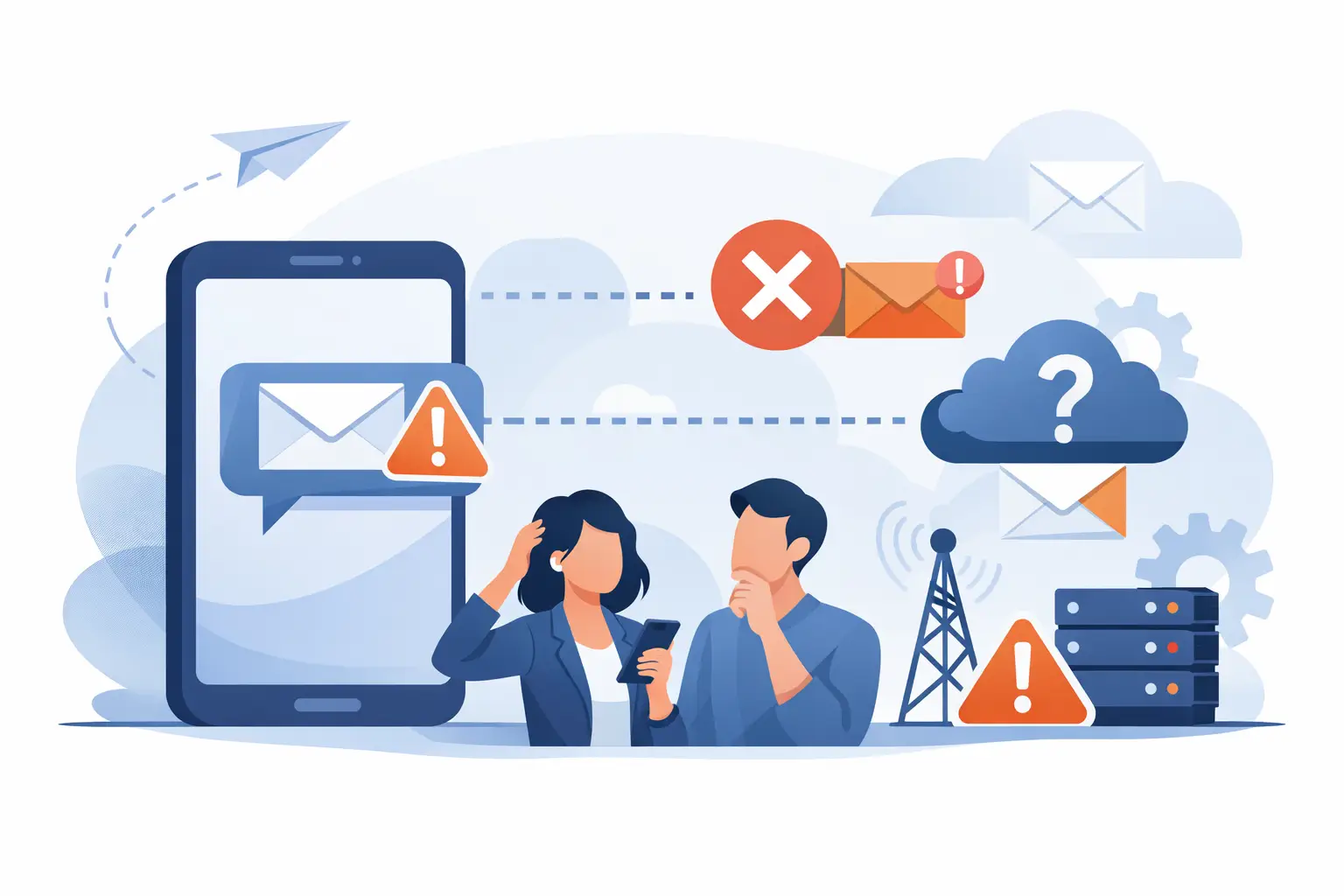
A client is waiting for the OTP code, an order needs to be confirmed, and the promotional campaign has just left the platform. If the message doesn't appear on the phone in a few seconds or minutes, the question immediately arises: why aren't the SMS messages arriving? For a business, the answer is not just about user comfort, but about conversions, unnecessary support load, blocked authentication, and lost trust.
The problem is that SMS delivery doesn't have a single cause. Sometimes the message is sent correctly but is stopped by the operator. Other times the number is no longer active, the recipient's phone has restrictions, the route is congested, or the message type doesn't comply with network rules. To resolve it quickly, you need to separate symptoms from the real cause.
Why SMS messages don't arrive in practice
In the business environment, most delivery failures occur in five areas: incorrect data, the recipient's device, the phone operator, sending configuration, and compliance rules. If you try to treat everything as a simple "network error," you waste time and solve nothing.
The first check is trivial but essential: the phone number. An incorrect format, a missing prefix, or a recycled number can cause the message not to arrive, even though the system accepted it for sending. Especially in bulk campaigns or automated flows, an old database quickly generates costs and poor results.
The second common cause is the actual state of the number. The user may have a deactivated SIM, may be roaming with restrictions, may have a full phone memory, or may use filters that block unknown senders. For OTP and transactional notifications, these cases are immediately visible through increased repeated requests.
The third area concerns operators and routing. Even if the platform correctly handed over the message, the recipient's operator may delay, filter, or reject the message depending on traffic, local policies, content, or sender type. This is where the difference between "sent" and "delivered" appears. For many companies, this is the main source of confusion.
Configuration issues that block delivery
If you send messages on a large scale or have API integrations, configuration matters more than it seems. An inappropriate sender ID for the destination country can reduce deliverability. In some markets, the alphanumeric sender ID is accepted, in others not. If you use an inappropriate configuration, the message can be rejected or rewritten by the operator.
And the type of message matters. OTP, transactional alert, and promotional campaign are not treated identically across all networks. A promotional-looking message sent on a route intended for authentication may be filtered. Similarly, a large volume delivered in a very short time can create delays if there isn't a good throttling and prioritization logic.
The API is another source of problems. Missing parameters, incorrect character encoding, improper handling of response statuses, or aggressive retries can produce duplicate messages, sending failures, or misleading reports. From the outside, it seems like "the SMS doesn't arrive," but the real cause is in the implementation.
For technical teams, visibility is critical. You need clear statuses, delivery reports, and simple diagnostic rules. Without these, support investigates blindly, marketing doesn't know if the database has issues, and the product can't separate a punctual incident from a systemic error.
When the operator or network is the cause
Not every undelivered message indicates an internal problem. There are situations where the mobile operator applies anti-spam filters, prioritizes traffic, or has temporary blockages. This is especially visible during high traffic periods, seasonal campaigns, or busy time windows.
There is also the scenario where the number has been ported to another network. If routing doesn't correctly account for portability, delays or rejections can occur. For companies that send large volumes, MNP and HLR checks significantly reduce these errors because they show the current network and the number's status before sending.
Geography also matters. International delivery comes with different rules from one country to another, and what works excellently in one market may perform poorly in another. Sender registration requirements, content limitations, and local marketing rules can radically change the results.
Why SMS messages don't arrive for OTP and verification
Here the stakes are higher because we're not just talking about communication, but about account access, security, and the completion of critical processes. If why SMS messages don't arrive becomes a frequent question in authentication flows, users quickly abandon, and the pressure shifts to the support team.
OTPs frequently fail for a few clear reasons: the recipient's phone doesn't have enough signal, the message arrives late and the code expires, the operator filters repetitive messages, or the entered number is incorrect. In other cases, the user requests multiple codes successively, and the system invalidates one before the other is received.
That's why good verification flows don't rely solely on quick sending. They include realistic validity windows, controlled retry rules, deduplication, and visibility over the status of each message. If you send sensitive codes, infrastructure reliability is not a technical detail but part of the product.
How to quickly identify the real cause
The first step is to check if the problem affects a single user, a single operator, or the entire base. If you see isolated complaints, you probably have a combination of incorrect data, inaccessible phone, or local filters. If the problem occurs simultaneously for multiple recipients in the same network, it is worth investigating the route and the relationship with the operator.
The second step is to compare the message stages. Was it accepted by the platform? Was it handed over to the operator? Is there a delivery confirmation or error code? Without this sequence, teams tend to mix sending with delivery and draw incorrect conclusions.
The third step is number validation. An HLR check can show if the number is active and available for SMS. An MNP check helps with correct routing to the current network. For companies that send frequently, these checks reduce both unnecessary costs and the failure rate.
In parallel, it is worth analyzing the content. Messages with many links, aggressive wording, or elements resembling spam can be treated differently. This doesn't mean you have to become sterile in communication, but tone and structure influence deliverability more than many marketing teams believe.
What you can do to increase deliverability
A good infrastructure starts with clean data. Normalize numbers, eliminate duplicates, check international formats, and constantly update the base. If you send to old lists, you'll pay for errors you can easily avoid.
Then clearly separate the types of traffic. Promotional, transactional, and OTP messages have different objectives and need to be managed differently. If you send them on the same logic, you risk blockages, delays, and unclear reports. Correct prioritization protects exactly the messages that cannot afford delays.
The platform you use also matters. You need real delivery reports, fast support, and technical options that reduce risk before sending. A solution like SMSense is useful precisely because it brings bulk messaging, OTP, number verification, and API integration in one place, without unnecessary complications.
Last but not least, test constantly. Not just before launch, but also after operator changes, new markets, large campaigns, or product updates. Deliverability is not set once and for all. It is a process that requires monitoring and adjustments.
When the problem is not technical, but process-related
Sometimes messages arrive, but too late to be useful. For a limited offer or a verification code, this is almost equivalent to non-delivery. In such cases, the problem comes from processes: poorly chosen sending windows, overlapping automations, lack of prioritization, or weak retry rules.
That's why the correct answer to the question of why SMS messages don't arrive is not always "change the provider" or "it's the operator's fault." Sometimes you need to clean the base, redo the sending logic, separate flows, and use number verifications before sending. When you treat delivery as a critical business function, not just as a send button, the results change visibly.
If your messages need to generate sales, confirm orders, or allow account access, every minute counts. And the best time to resolve deliverability is before the user tells you they haven't received anything.